
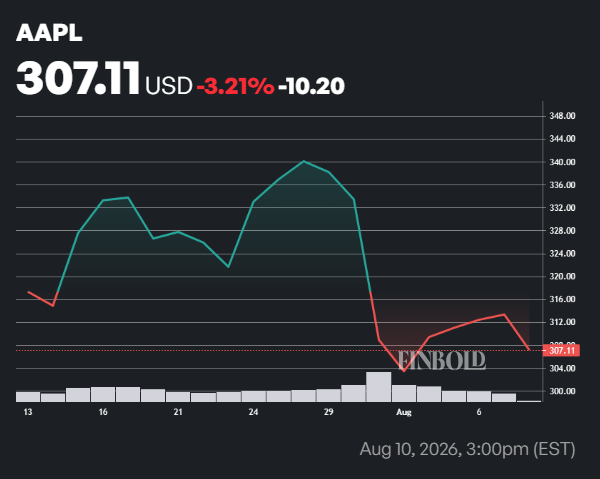
Apple stock has fallen more than 10% from its all-time high over the past three weeks, and Wall Street is split on what comes next after Jefferies analyst Edison Lee downgraded the stock to “Underperform” from “Hold” on August 10, citing the reported cancellation of the company’s long-rumored all-glass iPhone redesign.
Lee cut his 12-month price target to $263.66 from $285.56, a 7.67% reduction that implies roughly 14% downside from Apple’s trading price of about $307.11 at the time of the call. That puts Jefferies well outside the broader Wall Street consensus: the average 12-month target across 30 analysts tracked by TipRanks sits at $334.43, implying an 8.9% gain, with individual targets ranging from $245 to $400.
Why the all-glass iPhone mattered
Apple had reportedly been developing an all-glass iPhone as a flagship redesign to mark the device’s 20th anniversary, expected to launch in 2027 at a blended retail price Jefferies estimated near $2,060. According to supply-chain reporting, the project was shelved after manufacturing yield problems proved difficult to resolve, removing what Lee viewed as one of Apple’s clearest paths to raising its average selling price at a moment when component costs are climbing sharply.
Related: SpaceX Stock Rises Back Above IPO Price After 30% Rally in 3 Days
A memory squeeze hits the whole industry
The bigger structural problem Lee flagged is memory. Cloud providers and AI companies are absorbing an outsized share of global DRAM capacity for 2027, leaving smartphone and PC makers competing for a shrinking allocation — a dynamic pushing component costs higher across the industry, not just at Apple. Lee also pointed to the slower rollout of Apple Intelligence as a complicating factor, arguing it makes the higher memory requirements needed for on-device AI features harder to justify against their added cost.
A volatile stretch for mega-cap tech
Apple’s roughly 3.21% slide over the past 30 days and its now-$4.6 trillion market capitalization make it a bellwether for broader risk appetite in tech and growth stocks — the same appetite that tends to move in tandem with bitcoin and other risk assets during periods of macro uncertainty. The split between Jefferies’ bearish call and Wall Street’s still-bullish consensus underscores how unsettled the outlook for AI-era hardware costs has become heading into 2027.


