
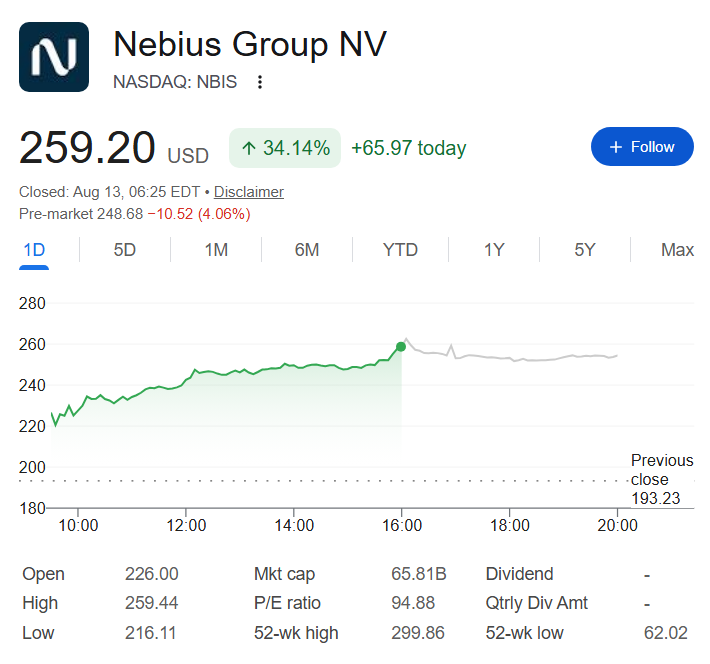
Nebius Group shares fell 4.06% overnight, slipping from a previous close of $259.20 to $248.68, as investors booked profits following an explosive two-day run. The pullback comes after the AI infrastructure company gained 34.14% in a single session and 26.29% over the past week, a rally finbold characterized as a correction within an otherwise strong move rather than a sign of a deeper problem.
The surge that preceded Thursday's dip was driven by Nebius' second-quarter results, which beat expectations on nearly every line. Revenue jumped 454% year-over-year to $582 million, ahead of the $570 million analysts had forecast, while the company's loss per share narrowed 68% to $0.12. Its annualized run rate, a forward-looking measure of revenue pace, reached $3 billion.
A Short Seller's Bet Goes Underwater
The rally has put real pressure on one of Wall Street's best-known bears. Michael Burry, the Scion Asset Management founder who famously called the 2008 housing crash, disclosed on his Cassandra Unchained newsletter on August 6 that he had shorted Nebius at $211.77 a share, alongside a separate short against Oracle at $144.63. He described the trades as “a bit like shooting fish in a barrel,” arguing that AI infrastructure firms are understating depreciation on their GPU fleets and therefore overstating true profitability.
Burry opted for a direct short position rather than options on Nebius specifically because put implied volatility had climbed above 100%, making derivatives too expensive to use efficiently. With shares now trading near $249, well above his $211.77 entry, the position has moved firmly against him even after Thursday's pullback — Nebius would need to fall more than 15% from current levels just to bring the trade back to breakeven.
Related: Nebius Surges 77% in 14 Days as Burry Doubles Down on His Short
Questions About Durability Remain
Even bulls acknowledge the annualized run-rate figure carries caveats, since it extrapolates a single period's results rather than reflecting contracted, multi-year revenue. Nebius and rival CoreWeave both continue to operate at a loss while carrying heavy capital expenditure loads to build out data center capacity, and roughly 70% of current AI infrastructure demand is reportedly concentrated in just two customers, OpenAI and Anthropic — a concentration risk that could weigh on the stock if either company's spending plans shift.


