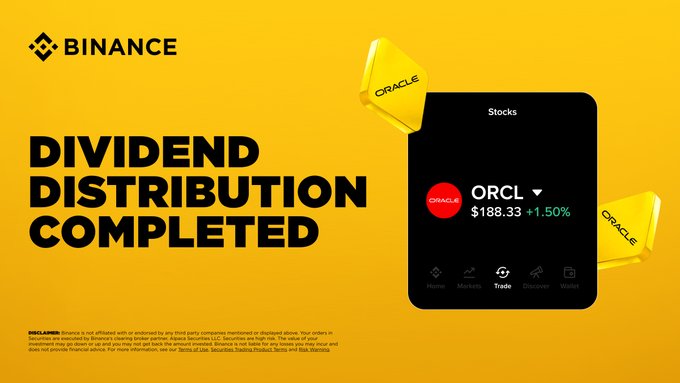
Binance has distributed dividend payments for Oracle (ORCL) tokenized shares directly to the Funding Wallets of eligible users, the exchange announced. Anyone who held ORCL shares on Binance Stocks before the July 10, 2026 record date is now able to see the payout reflected in their account.
The dividend was paid at a rate of $0.50 USD per share and distributed in USDC, the exchange's stablecoin of choice for settling these payouts. The move is part of Binance's ongoing effort to mirror the economics of holding traditional equities within its tokenized stock product, allowing users to receive dividend income without needing a traditional brokerage account.
How Binance Stocks Handles Dividends
Binance Stocks lets users gain exposure to shares of publicly traded companies through tokenized instruments that track the underlying asset's price. When a company like Oracle issues a dividend to its shareholders, Binance passes an equivalent cash payment through to holders of the corresponding token, converted into USDC and credited automatically to the user's Funding Wallet, with no manual claim process required.
This automatic settlement model has become a selling point for exchanges competing in the growing tokenized equities space, where firms are racing to offer crypto-native access to traditional markets with features that closely replicate the shareholder experience, including corporate actions like dividends and stock splits.
Part of a Broader Push Into Tokenized Equities
The ORCL payout adds to a growing list of dividend distributions Binance has processed for its stock token holders as the exchange continues expanding its tokenized stock offerings. As more traditional companies see their shares tokenized and made available to crypto-native traders, dividend processing has become a routine but closely watched feature, since it signals how seriously exchanges are treating the tokenized stock category as a long-term product rather than a novelty listing.