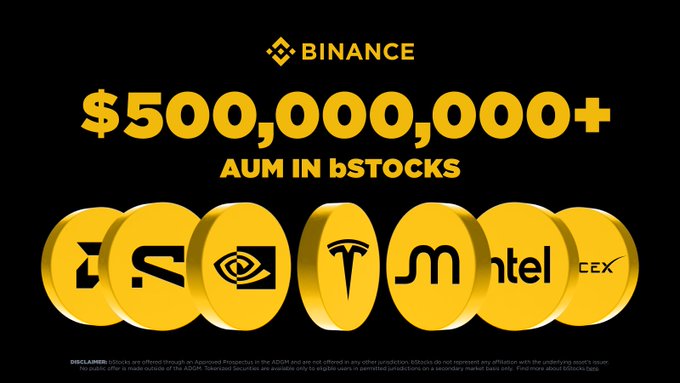
Binance's tokenized equity product, bStocks, has crossed $500 million in assets under management just seven weeks after launch, according to figures the exchange shared this week. The product launched on June 11 with $5.6 million in AUM and grew more than eightyfold to surpass the half-billion-dollar mark by July 28, 2026.
bStocks lets users hold tokenized exposure to real equities that trades around the clock, a structural departure from traditional stock markets that close outside standard trading hours. Binance says the product supports free conversion between tokenized shares and other assets on the platform, with trading available continuously rather than limited to exchange hours.
What the Growth Signals
The pace of the climb, from single-digit millions to nine figures in under two months, suggests meaningful demand from users who want equity exposure without the settlement delays or hour restrictions of conventional brokerages. Binance has framed the growth as evidence that users are not merely trading the tokens speculatively but holding them for genuine equity exposure.
The bStocks launch fits into a broader pattern among major exchanges racing to offer tokenized real-world assets, particularly equities, as a bridge between crypto-native trading infrastructure and traditional capital markets. Competitors including Bybit and Bitget have rolled out comparable tokenized-stock and stock-perpetual products in recent months, each citing similar user demand for 24/7 access to equity-linked instruments.
Questions Around Sustainability
Whether the current growth rate holds will depend partly on broader market conditions and partly on whether users continue treating bStocks as a long-term holding rather than a short-term trading vehicle. Binance has not disclosed a breakdown of which underlying stocks account for the bulk of the AUM, nor how concentrated the holdings are among its largest users.
For now, the milestone underscores how quickly tokenized equities have moved from a niche offering to a product capable of attracting nine-figure sums within weeks, a trend likely to draw further scrutiny from regulators as exchanges expand access to synthetic stock exposure outside traditional brokerage rails.