Bybit has published its 38th Proof of Reserves report, expanding coverage to 10 additional tokens and pushing the value of mainstream assets covered past $16.5 billion. The report was independently verified by blockchain security firm Hacken, according to the exchange.
The newly added tokens include GRAM, XAUT (Tether Gold), HYPE, STABLE, ENA, ARB, ASTER, ONDO, AAVE, and USD1 — broadening the report beyond Bybit's core holdings to capture a wider slice of assets held on behalf of users.
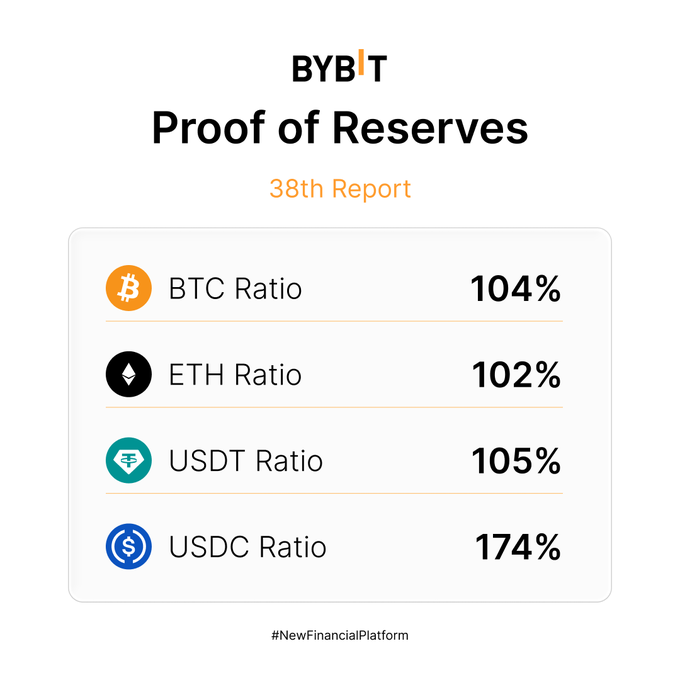
Core Assets Remain Fully Backed
Bitcoin, Ethereum, USDT, and USDC continue to maintain reserve ratios that fully back user holdings on the exchange, according to the report. Proof of Reserves audits have become a standard transparency mechanism among major exchanges since the collapse of FTX in 2022, when the absence of any independent verification of customer asset backing contributed to the scale of user losses.
By publishing these reports on a recurring basis — this is Bybit's 38th release — the exchange is signaling an ongoing commitment to third-party verification rather than a one-off disclosure. Expanding the list of covered tokens with each iteration also reflects growing pressure on exchanges to demonstrate backing not just for major assets like Bitcoin and stablecoins, but for the broader range of tokens users actually hold on the platform.
Why Independent Verification Matters
Hacken's role as an independent auditor is central to the report's credibility — without third-party verification, a proof-of-reserves disclosure amounts to a self-reported claim. Cryptographic proof-of-reserves methods typically combine on-chain wallet attestations with merkle-tree techniques that let individual users verify their own balances were included in the audited total, without exposing other customers' account details.
Proof-of-Reserves attestations like this one exist largely because of what happened at FTX — independently verifying that an exchange actually holds the customer assets it claims to, audited here by Hacken, has become a standard trust signal major exchanges compete on since 2022's collapse made the risk of an unbacked exchange painfully concrete. Adding tokens like XAUT, HYPE and AAVE to the covered list, on top of mainstream assets already topping $16.5 billion, reflects how far these audits have expanded beyond just Bitcoin and Ethereum reserves.
FAQ
What does a Proof-of-Reserves audit actually verify?
It independently confirms that an exchange holds enough of each asset on its own books to cover what it owes customers — the kind of verification that was notably absent at FTX before its collapse.
Who audited this report?
Hacken, a blockchain security firm that regularly performs these attestations for major exchanges.
Related: Bybit Expands Pre-IPO Perpetuals With Unitree, Moonshot AI Contracts