The Federal Reserve is scheduled to pump $15.5 billion into the financial system over the next three weeks, adding to a liquidity program that has been running quietly in the background even as the central bank simultaneously weighs whether to raise interest rates for the first time in years.
The injection continues a pattern the Fed set in motion when it ended quantitative tightening on December 1, 2025. Since then, the New York Fed's markets desk has been conducting reserve management purchases, buying Treasury bills to keep bank reserves in the “ample” range rather than letting them drain further, at a pace that has run near $40 billion a month by some estimates. The $15.5 billion figure over three weeks is consistent with that cadence, and it lands at a moment when reserve levels are being watched more closely than usual because of how tight repo markets became at the end of last year.
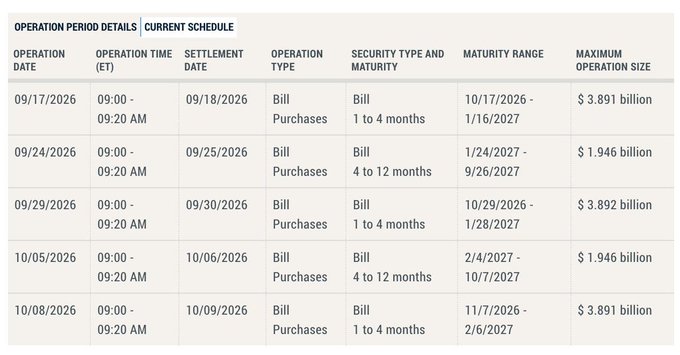
What makes the timing notable is the contrast with where rate expectations have moved. Sixteen of the 20 largest banks now expect the Fed to raise rates this month rather than cut them, a reversal from the easing path markets were pricing for much of the year, and August's inflation print did nothing to change that calculus: CPI held at 3.4% while hike odds jumped to 90% on futures markets. A central bank adding reserves to the system while simultaneously preparing to tighten policy through rates is an unusual combination, and it reflects a split inside the Fed's own toolkit: reserve management purchases are a plumbing operation meant to keep short-term funding markets functioning smoothly, not a signal about the target rate itself. The two can move in opposite directions without being contradictory, but it does complicate the read for traders trying to gauge whether liquidity conditions are loosening or tightening overall.
The backdrop for that rate debate is the same oil-driven inflation pressure rippling through the rest of the market this week. Surging energy costs tied to the Middle East supply disruptions have pushed up both consumer prices and Treasury yields, giving hawks on the committee more ammunition even as the Fed keeps its foot on the liquidity accelerator through bill purchases.
Related: Goldman, JPMorgan Flip to Fed Hike Call Days Before FOMC Meeting
For risk assets, the net effect of a liquidity add during a hiking cycle is ambiguous. More reserves in the banking system can support demand for assets like bitcoin and equities at the margin, but a hike itself typically pressures the same assets by raising the cost of leverage and making cash more attractive. That tension has shown up recently in crypto fund flows, where bitcoin ETFs have extended an outflow streak to four days even as ether ETFs pulled in fresh inflows, a split that suggests investors are already positioning unevenly rather than treating the liquidity backdrop as uniformly bullish. Whether the $15.5 billion add is enough to offset tighter rate policy, if a hike does land this month, will likely depend more on how the Fed frames its rate decision than on the size of the bill purchases themselves.
The plumbing concerns behind these purchases are not hypothetical. By the end of 2025, the Fed's own researchers had concluded that bank reserves had slipped from what they call “abundant” to merely “ample,” a downgrade that showed up almost immediately in repo rates, which crept higher as year-end funding pressure built. That is the specific stress the reserve management purchase program was designed to head off, and it is why the Fed has kept buying bills on a steady schedule even while it debates the separate question of where to set the policy rate. The two levers, balance sheet plumbing and the federal funds rate, are run by different parts of the same institution and can point in different directions without any contradiction in the Fed's broader stance, but that nuance is easy to lose in a single headline number like $15.5 billion.