Highlights
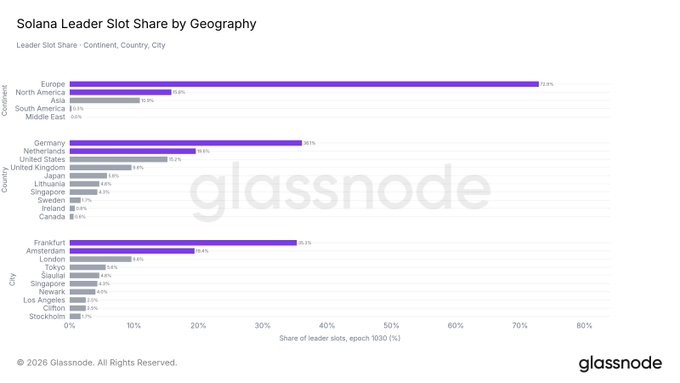
- Frankfurt and Amsterdam together produce more than half of all Solana blocks, at 33% and 19% respectively.
- 310 of Solana's 675 validators sit in those two cities alone.
- That's 46% of the network by validator count and 53% by staked value concentrated in two data-center hubs.
- The concentration is tied to both cities' low-latency connectivity to Solana's global validator mesh.
Two European cities now account for more than half of all block production on Solana, according to data from Glassnode's validator latency monitor. Frankfurt alone produces 33% of Solana blocks, with Amsterdam contributing another 19%, for a combined 52% of total block production concentrated in just two metro areas. The two cities host 310 of Solana's 675 total validators — 46% of the network by validator count. Weighted by stake, the concentration is even higher: those 310 validators control 53% of total staked SOL securing the network, meaning a majority of Solana's economic security now effectively runs through Frankfurt- and Amsterdam-based infrastructure.
Why Validators Cluster in These Two Cities
The concentration isn't accidental. Glassnode's latency-monitoring dashboard, which tracks QUIC handshake latency to nearly all of Solana's roughly 760 voting mainnet validators in real time, has documented this trend building for months: as of a July snapshot, Europe already accounted for roughly two-thirds of leader slots, with average latency from Frankfurt clocking in around 72 milliseconds compared to 140 milliseconds from the US East Coast. Solana's consensus design rewards validators that can propagate blocks and votes with minimal delay, which creates a structural incentive for validators to co-locate near the network's busiest data-center corridors rather than spread out geographically. Frankfurt and Amsterdam, both established European internet exchange hubs with dense fiber connectivity, have become the natural gravity well for that incentive.
Infrastructure providers have reinforced the pattern. Hosting data reviewed alongside Glassnode's July figures showed a single provider, TeraSwitch Networks, hosting roughly 59% of validators and producing a similar share of leader slots — meaning the concentration risk isn't just geographic, but also runs through a small number of data-center operators within those cities.
Related: Solana On-Chain Transactions Hit Record 4.2B in July as SOL Rallies 40%
What Validator Concentration Means for Solana
For a network that markets itself on speed and low fees, latency-driven validator clustering is in some ways a rational outcome rather than a flaw — it's the same dynamic that concentrates traditional high-frequency trading infrastructure near major stock exchange data centers. But it also raises the kind of decentralization questions that have followed Solana since its early days: with roughly half the network's validators, and more than half its staked value, running through two cities and a handful of data-center providers, a regional power outage, fiber cut, or targeted regulatory action in Frankfurt or Amsterdam could have an outsized effect on Solana's block production and finality, more than the same event would on a more geographically distributed network.
The timing adds context. Solana recently hit a record 1.01 billion weekly non-vote transactions, a scale of activity that only intensifies the pressure on validators to minimize latency to stay competitive for leader slots and MEV opportunities — which in turn reinforces the incentive to cluster near the fastest connectivity rather than diversify geographically. The network's growing transaction volume and its growing infrastructure concentration appear to be feeding each other.
What to Watch Next
Solana's core developers have periodically discussed incentive tweaks aimed at rewarding geographic and infrastructure diversity among validators, though no binding change specifically targeting the Frankfurt-Amsterdam concentration has been implemented. A recent validator vote on Solana's fee burn rate shows the community is actively engaged in governance debates that touch validator economics, and similar proposals addressing geographic concentration could surface as the issue draws more attention. Watch for whether Glassnode's dashboard shows the concentration continuing to climb or beginning to level off in the coming months.
FAQ
What share of Solana blocks come from Frankfurt and Amsterdam?
Frankfurt produces 33% and Amsterdam 19% of Solana blocks, a combined 52%, according to Glassnode's validator latency data.
How many Solana validators are based in these two cities?
310 of Solana's 675 total validators are located in Frankfurt and Amsterdam, representing 46% of the network by validator count.
Why do Solana validators cluster geographically?
Solana's consensus rewards low-latency block and vote propagation, so validators gravitate toward cities with dense, high-speed internet connectivity like Frankfurt and Amsterdam.
Is this concentration a security risk for Solana?
It raises decentralization concerns, since a regional disruption in Frankfurt or Amsterdam could disproportionately affect block production, though it hasn't caused a network failure to date.