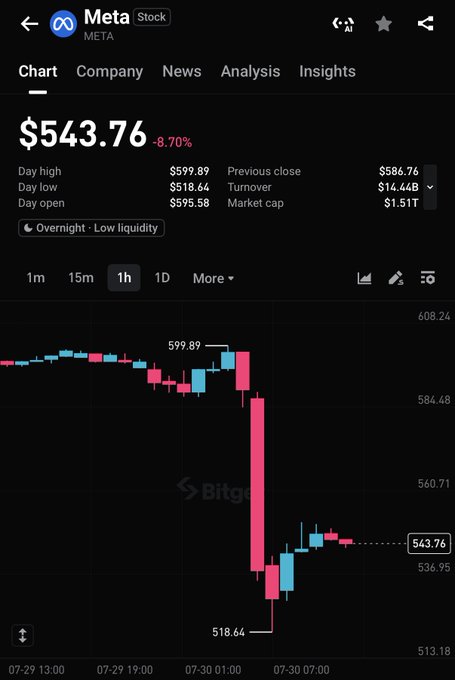
Meta Platforms shares fell 8.7% after the company's second-quarter results missed Wall Street's profit estimate and management raised its capital-expenditure outlook again, according to figures circulated by Bitget's TradFi desk. Revenue came in at $60.8 billion, edging past the $60.3 billion analysts had projected, but earnings per share of $6.18 landed well short of the $7.22 consensus.
Meta guided for third-quarter revenue of $61 billion to $64 billion, a range broadly in line with where analysts had positioned the stock heading into the print. The gap between a revenue beat and a sizable profit miss is what drove the sell-off, with investors reading the results as evidence that heavy AI infrastructure spending is compressing margins faster than it is generating returns.
Why the Profit Miss Outweighed the Top-Line Beat
An earnings-per-share miss alongside a revenue beat typically points to rising costs eating into the bottom line, and Meta's repeated upward revisions to capital expenditure guidance have been the clearest driver. The company has been pouring money into data centers and custom AI silicon, and the market's reaction suggests patience for that spending to convert into per-share profit growth is wearing thin.
The Bigger AI Capex Debate
Meta's report lands in the middle of a broader reckoning across mega-cap tech, where every major AI spender is being asked the same question: how long can capital expenditure outrun profit growth before investors demand proof of return. The size of the after-hours move, nearly 9%, signals that for Meta specifically, the market's tolerance is narrowing.
The reaction also carries relevance beyond traditional equity markets. Meta is among the large-cap names available as a tokenized or leveraged trading instrument on several crypto exchanges, meaning the earnings-driven price swing is likely to ripple into on-chain stock-token and perpetual markets outside the Nasdaq session itself.
The full picture was more nuanced than the headline EPS miss suggests. Reality Labs posted a $4.6 billion quarterly loss — squarely within its historical $4.2–6.0 billion loss range over the past two years — but its revenue actually grew 16% year-over-year to $431 million, driven by strong AI glasses sales offsetting weaker Quest headset demand. The real pressure point was cash flow: $31.1 billion in quarterly capital expenditure consumed nearly all of Meta's operating cash flow, leaving free cash flow at just $784 million. Investors reacted less to the revenue beat and more to what accelerating AI infrastructure spending is doing to near-term profitability, the same tension playing out across Nvidia's own AI-capex-related stock moves.
FAQ
Is Reality Labs' business actually improving or getting worse?
Mixed — its quarterly loss of $4.6 billion is consistent with its typical historical range, but revenue grew 16% year-over-year to $431 million on stronger AI glasses sales, even as Quest headset demand softened.
Why did the stock drop if revenue beat estimates?
Massive AI infrastructure capital expenditure ($31.1 billion for the quarter) consumed nearly all of Meta's operating cash flow, leaving free cash flow at just $784 million — a profitability concern that outweighed the revenue beat for investors.