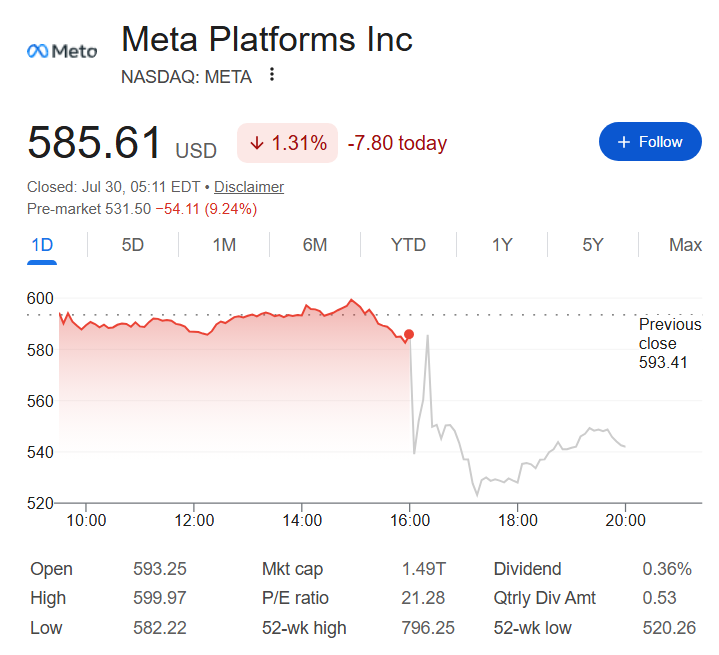
Meta Platforms shares collapsed 9.24% overnight between July 29 and July 30, sliding from $585.61 to $531.50 and erasing an estimated $320 billion in market capitalization. The drop pushed the social media giant's valuation from $1.67 trillion at the end of 2025 down to roughly $1.35 trillion in Thursday's pre-market session, extending a year-to-date loss that now stands at 18.28%.
The rout followed Meta's second-quarter 2026 results, where earnings per share came in at $6.18 against an expected $7.22 — a miss that traders treated as the clearest trigger for the sell-off. Revenue actually beat estimates, coming in at $60.80 billion versus a forecast of $60.17 billion, but that wasn't enough to offset concerns elsewhere in the report.
Guidance and Cash Flow Raise Red Flags
Meta's forward guidance did more damage than the earnings miss itself. The company projected third-quarter revenue of between $61 billion and $64 billion, a midpoint of $62.5 billion that falls short of the $63.15 billion analysts had penciled in. That guidance gap signaled to investors that growth may be decelerating just as spending accelerates.
Free cash flow told an even starker story. The metric fell to just $784 million, down sharply from $8.5 billion a year earlier — a decline of more than 90% that immediately drew scrutiny from analysts parsing the earnings call.
Capital Spending Keeps Climbing
Compounding the cash flow concern, Meta raised its capital expenditure projection for the year to a range of $130 billion to $145 billion, up from a prior forecast of $125 billion to $145 billion. The upward revision underscores how much the company continues to plow into AI infrastructure even as free cash flow shrinks.
The pattern echoes a broader trend playing out across Big Tech this earnings season: markets have grown less tolerant of ballooning AI capital expenditure when it isn't paired with commensurate near-term cash generation, and Meta's report gave investors a textbook example of exactly that mismatch.
What It Means for Wider Markets
Meta's slide adds to a jittery week for tech investors already digesting mixed signals from other mega-cap earnings reports. Whether the stock stabilizes will likely hinge on how the company frames its AI spending trajectory relative to revenue growth in the coming quarters.