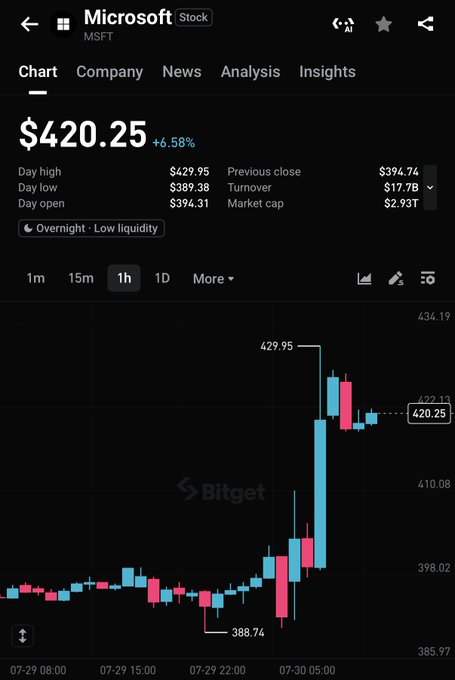
Microsoft shares jumped 7% after the company reported that its Azure cloud division crossed $100 billion in annual revenue for the first time, a threshold that underscores just how large the cloud business has grown alongside the company's broader AI push. Azure's revenue grew 43% year-over-year, a pace that outstripped what many investors had been expecting heading into the earnings report.
Notably, Microsoft kept its fiscal year 2026 capital expenditure guidance unchanged even as Azure's growth accelerated, signaling that the company believes its existing infrastructure investment plans can support the expansion without requiring an upward revision to spending.
A Cash-Flow Positive Target for 2027
Microsoft also reaffirmed that it still expects to remain cash-flow positive in 2027, a detail that matters given how closely markets have been scrutinizing Big Tech's ability to fund massive AI infrastructure buildouts without straining their balance sheets. Holding the capex line steady while delivering an earnings beat is precisely the combination investors have been rewarding this earnings season.
Standing Out in a Mixed Earnings Season
The reaction stands in contrast to other mega-cap tech names that have unsettled markets this quarter by raising spending forecasts alongside earnings misses. Microsoft's ability to post accelerating cloud growth without hiking its own capex guidance has made it something of a benchmark for how investors are now judging AI-era earnings reports across the sector.
Related: Bitcoin Holds Near $64K as Microsoft's Cloud Growth Lifts Stocks
The full quarter beat expectations across the board: adjusted earnings of $4.74 per share on $90.01 billion in revenue, both ahead of analyst estimates of $4.24 and $87.62 billion respectively, with net income climbing to $35.77 billion from $27.23 billion a year earlier. Azure's growth rate itself accelerated to 43% (from 40% the prior quarter), pushing full fiscal-year 2026 Azure revenue past $100 billion for the first time — up 41% year-over-year. Notably, Microsoft actually revised its 2026 capital expenditure forecast down, to roughly $175 billion from an earlier $190 billion estimate, by extending the assumed useful life of its data center and office properties from 15 to 25 years — an accounting change that reduces near-term reported capex without necessarily reducing physical infrastructure investment.
FAQ
Did Microsoft's stock react to more than just the Azure milestone?
Yes — earnings and revenue beat analyst estimates across the board, with net income up roughly 31% year-over-year, contributing to the 7-8% share price jump alongside the Azure news.
Why did Microsoft lower its capex forecast despite growing AI investment?
It extended the assumed useful life of its data centers and office properties from 15 to 25 years, an accounting change that reduces near-term reported capital expenditure without necessarily reducing actual infrastructure spending.