Highlights
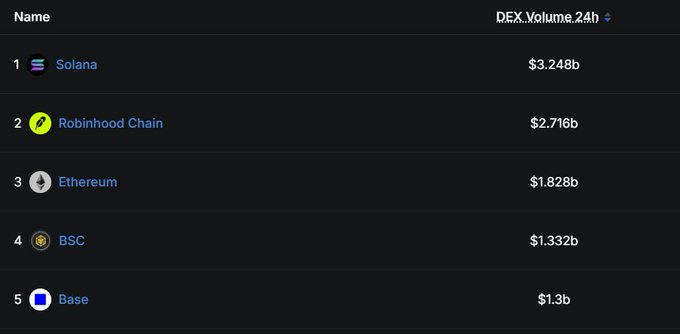
- Solana posted $3.25 billion in 24-hour DEX volume, retaking the top spot from Robinhood Chain's $2.72 billion, according to DefiLlama.
- Robinhood Chain had briefly flipped Solana on September 5, generating $1.45 billion against Solana's $1.25 billion that day.
- Solana still leads by a wide margin over 30 days, with more than $65 billion in cumulative volume versus Robinhood Chain's roughly $15 billion.
- Robinhood Chain's 90-day gas subsidy expires September 29, and traders are watching whether its volume survives the switch to paid transactions.
Solana has taken back the throne it only just lost. Twenty-four hours of decentralized exchange activity now favor the incumbent chain by a comfortable $530 million margin, with Solana clearing $3.25 billion against Robinhood Chain's $2.72 billion, according to DefiLlama's chain rankings. A week ago, the story ran the other way.
Robinhood Chain's mainnet launched on July 1, and within nine weeks it had done something no challenger had managed before: on September 5 it out-traded Solana on a single day, $1.45 billion to $1.25 billion. The flip was driven less by organic demand than by a blunt incentive — every transaction on Robinhood Wallet has been free for the network's first 90 days, a subsidy that made the chain a magnet for memecoin traders and, per its backers, an eventual venue for tokenized real-world assets.
The subsidy's effect shows up even more starkly in revenue than in volume. On September 2, Robinhood Chain generated $4.01 million in daily fee revenue against Solana's $81,714 on the same leaderboard — a 22-fold jump from the $179,815 Robinhood Chain had logged just six days earlier. But that revenue is almost entirely an application-layer artifact: fees from Pons, GMGN and Uniswap-style spreads, not the gas costs users would normally pay to validators. Robinhood itself is effectively subsidizing the appearance of network activity.
That distinction matters for how the flippening should actually be read. Robinhood Chain's pitch to the market was never just about memecoins — the company has framed the chain as a venue for tokenizing real-world assets like stocks, positioning it as infrastructure for its broader brokerage business rather than a standalone DeFi competitor. A zero-fee environment is a reasonable way to bootstrap early liquidity and habit-formation for that longer-term goal, but it also means the September 5 flip told us more about the price of gas than about which network traders actually prefer once cost is equal.
That subsidy runs out on September 29, and the question hanging over Robinhood Chain is whether its traders are loyal to the chain or simply to the free ride. Memecoin traders are, by reputation, some of the most fee-sensitive users in crypto, quick to migrate wherever the next incentive appears. Solana and Base are the obvious landing spots if costs on Robinhood Chain rise even modestly, and past subsidy expirations across the industry have tended to produce sharp activity drop-offs rather than smooth transitions to organic usage.
Related: Solana's Best August Since 2024 Runs Into a Burn-Rate Vote
For Solana, reclaiming the daily crown is as much a reminder of scale as a genuine contest. Its cumulative 30-day volume near $65 billion is roughly three times Robinhood Chain's tally even after the newcomer's growth spurt, built on a base of established DeFi liquidity, market-maker relationships and retail habit that a 90-day promotion cannot replicate. The network has also been posting broader momentum this year, from SOL breaking back above $100 to record on-chain transaction counts that suggest the activity isn't purely mercenary.
The next two and a half weeks will be the real test of Robinhood Chain's traction. If volume holds anywhere close to current levels once gas fees kick in on September 29, it will have demonstrated genuine product-market fit rather than a subsidy-driven mirage. If it collapses back toward its pre-launch baseline, Solana's reclaimed lead will look less like a comeback and more like a reversion to the mean that was always coming.
Other chains have been through versions of this test before, and the pattern has rarely favored the incentivized newcomer once the incentive disappears. Subsidized transaction fees, liquidity-mining rewards and points programs have each, at different points in crypto's history, produced short-lived volume spikes that collapsed hard the moment the subsidy tapered off, because the activity was chasing the reward rather than the network itself. Robinhood Chain's advantage is that it can point to a real, sticky user base already inside Robinhood's brokerage app — a distribution channel most challenger chains never had. Whether that translates into DEX volume once the free ride ends is the actual question the next few weeks will answer.