Highlights
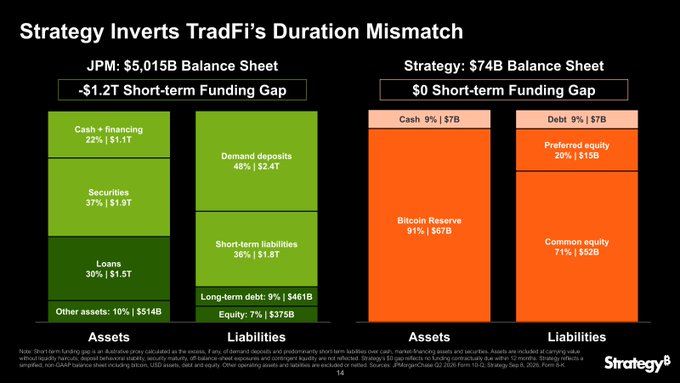
- Strategy claims 91% of its balance sheet is funded by permanent capital, versus 48% of JPMorgan's balance sheet funded by withdrawable deposits.
- The comparison frames Strategy's Bitcoin-backed structure as more stable than a traditional bank's, which can face depositor withdrawals on demand.
- JPMorgan's own mid-2026 filings show deposits at roughly 58% of total liabilities, a different but directionally comparable measure.
- Strategy has built its permanent-capital base largely through preferred stock, with over $15 billion in preferred shares outstanding as of mid-2026.
A Bank-vs-Bitcoin-Treasury Balance Sheet Comparison
Strategy, the bitcoin treasury company formerly known as MicroStrategy, used its official account to draw a pointed contrast between its own balance sheet and that of the largest US bank. The company said 48% of JPMorgan's balance sheet is funded by withdrawable deposits, money that can, in principle, leave the bank on short notice, while 91% of Strategy's own balance sheet is funded by what it calls permanent capital, meaning financing that cannot be pulled by a counterparty on demand. The framing was blunt: "$MSTR inverts TradFi," the company wrote, arguing that its structure is built to withstand exactly the kind of liquidity stress that has historically threatened traditional banks.
How Strategy Built a 91% Permanent-Capital Base
The comparison points to a genuine structural difference in how the two companies are financed. Banks like JPMorgan rely heavily on customer deposits, funds that are contractually repayable to depositors on demand or short notice, which is precisely why bank runs are possible when confidence evaporates. JPMorgan's own quarterly disclosures show deposits made up roughly 58% of total liabilities as of its most recent filing, down from 63% at the end of 2025, a different accounting lens than Strategy's own figure but directionally consistent with the idea that a majority of a large bank's funding is technically callable.
Strategy, by contrast, has spent the past several years building out a capital stack designed specifically to avoid that vulnerability. Rather than relying on deposits or short-term debt, the company has issued a growing menu of perpetual and long-dated preferred stock instruments, collectively exceeding $15 billion in notional value outstanding by mid-2026, alongside convertible debt with maturities stretched years into the future. None of these instruments can be redeemed on demand the way a deposit can, which is the structural basis for Strategy's claim that the vast majority of its funding is effectively permanent. The company has also actively managed that preferred stack, at times prioritizing buybacks of its own preferred shares over adding to its Bitcoin holdings when market conditions warranted it.
Why the Comparison Matters for Bitcoin's Treasury-Company Model
Related: Strategy CEO Vows to Outgrow Nvidia, Meta as $20.9B Raise Fuels BTC Stack
The comparison lands at a moment when Strategy's Bitcoin treasury model, and the wave of copycat companies it inspired, continues to face scrutiny over whether leveraged, preferred-stock-heavy balance sheets are actually safer or simply differently risky than a traditional bank's. Critics have long argued that Strategy's mandatory dividend obligations on its preferred stock create their own form of forced-selling pressure if Bitcoin's price falls far enough and dividend coverage becomes strained. Supporters counter that because none of that preferred capital can be yanked on short notice the way a deposit can, Strategy is structurally insulated from the sudden liquidity spirals that have periodically hit troubled banks.
For the broader Bitcoin market, the framing also reinforces a narrative Strategy has pushed consistently: that its balance sheet, however leveraged it may appear on the surface, is engineered to survive Bitcoin's volatility precisely because its capital cannot be pulled the way TradFi funding can be. That distinction matters most during sharp drawdowns, when treasury companies with less durable funding structures have historically been forced into disorderly selling. Strategy's reserve capital position has grown large enough that the company now ranks among the largest reserve holders in the S&P 500, giving this capital-structure debate outsized relevance for the index's own risk profile.
What to Watch Next
The next real-world test of this framing will come with Strategy's next quarterly capital-structure update, where the company typically discloses fresh detail on its preferred stock issuance, buyback activity, and dividend coverage ratios. Any material change in how much of the balance sheet remains genuinely permanent, particularly if the company leans further into debt or shorter-dated instruments to fund future Bitcoin purchases, would be the clearest signal of whether the 91% figure is durable or a high-water mark. Markets will also be watching whether other corporate Bitcoin treasuries adopt similar permanent-capital framing as they build out their own balance sheets.
FAQ
What does Strategy mean by "permanent capital"?
Permanent capital refers to funding sources, mainly perpetual and long-dated preferred stock and convertible debt, that cannot be redeemed or withdrawn by the holder on demand, unlike a bank deposit.
How much of JPMorgan's balance sheet is funded by deposits?
Strategy cited 48% funded by withdrawable deposits, while JPMorgan's own mid-2026 quarterly filing shows deposits at roughly 58% of total liabilities, a related but not identical measure.
How has Strategy built its permanent-capital base?
Largely through issuing preferred stock, which exceeded $15 billion in notional value outstanding by mid-2026, alongside long-dated convertible debt rather than short-term borrowing.
Why does this comparison matter for Bitcoin treasury companies?
It speaks to whether leveraged Bitcoin treasury balance sheets are more resilient than traditional bank funding during periods of stress, since permanent capital cannot be pulled the way deposits or short-term debt can.