Highlights
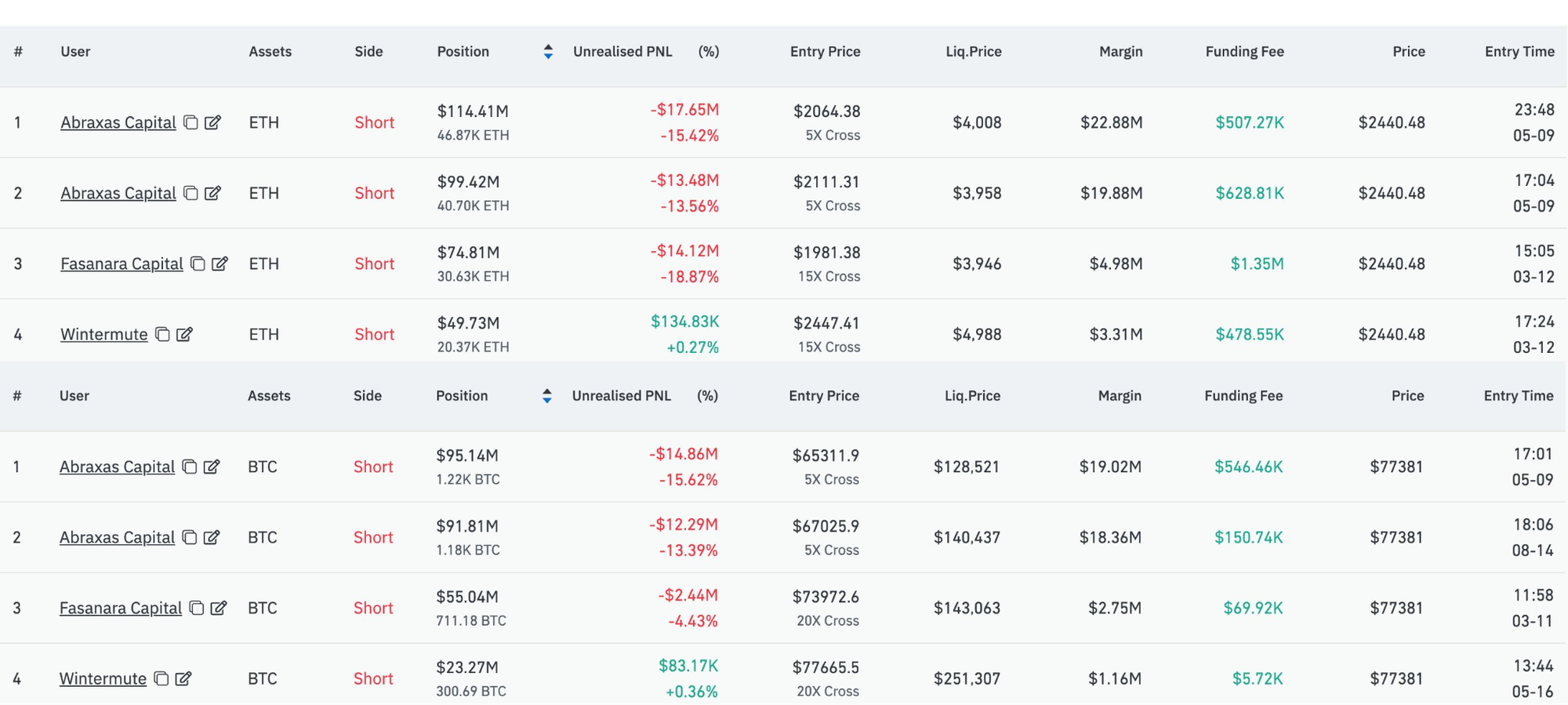
- Wintermute is carrying roughly $190.8 million in short positions on Hyperliquid, with about $5.85 million in unrealized losses as prices rebound.
- The shorts reflect delta-neutral market-making hedges, not a bearish bet, Wintermute's lifetime profit on Hyperliquid still exceeds $200 million.
- Other professional desks, including Abraxas Capital and Fasanara Capital, hold similarly large ETH and BTC shorts, reinforcing that this looks like inventory management rather than a coordinated bearish call.
- Bitcoin has rallied about 32% from its July low and is now testing the 50-week EMA, the level that has capped every rally this year.
- XRP's roughly 47% weekly gain and HYPE's rally have made Wintermute's shorts on those assets the most costly, an early signal of possible altcoin rotation.
One of the industry's largest market makers is carrying a heavy short book as Bitcoin rebounds 32% from its July lows. Reading those positions as bearish signals misunderstands how these desks actually work.
The headline writes itself: Wintermute, one of crypto's most prominent market makers, is sitting on approximately $190.8 million in short positions on Hyperliquid, with unrealized losses of around $5.85 million as prices bounce hard. The positions span Ethereum at roughly $53 million, Bitcoin at $30.7 million, Solana at $22.6 million, HYPE at $11.4 million, and XRP at $10.2 million.
It is the kind of data point that travels fast on crypto Twitter and generates immediate narrative: the smart money is short, the rally is fake, the crash is coming.
That narrative is almost certainly wrong, and understanding why reveals something more useful about where this market actually is.
What a $190 Million Short Book Actually Looks Like From the Inside
Wintermute's lifetime profit on Hyperliquid still sits north of $200 million. That context matters enormously. A firm that has generated more than $200 million in cumulative profit does not carry $190 million in directional shorts because it believes prices are about to collapse. It carries them because that is how market making works.
The mechanics are straightforward. A market maker provides continuous two-sided liquidity, it buys when others sell and sells when others buy. To remain delta-neutral through that process, it hedges its net long inventory with short positions. When markets rally, those hedges temporarily lose money. That is not a loss on a directional bet. It is the cost of providing liquidity in a rising market, and it is expected.
"Market makers short to stay delta-neutral, not because they are predicting a crash," Bitrue Research Institute noted in its August analysis. "When the market rips higher, those hedges temporarily lose money. That is simply the cost of providing continuous liquidity. Treating every large short as a bearish signal misunderstands how these desks actually operate."
The context from other professional desks reinforces the point. On-chain data shows Abraxas Capital, Fasanara Capital, and related wallets collectively short roughly 138,569 ETH, approximately $338 million, and 3,425 BTC, around $265 million. After the recent wave of liquidations forced out the speculative high-leverage traders, the large short positions that remain belong predominantly to professional hedging accounts. What the data shows is not a coordinated bearish call. It looks like inventory management.

Bitcoin's Technical Picture Is More Interesting Than Wintermute's Book
The more consequential story is what Bitcoin has done and where it now sits.
Related: Hyperliquid Tests Manual Borrowing, Opens HyperCore to Smart Contracts
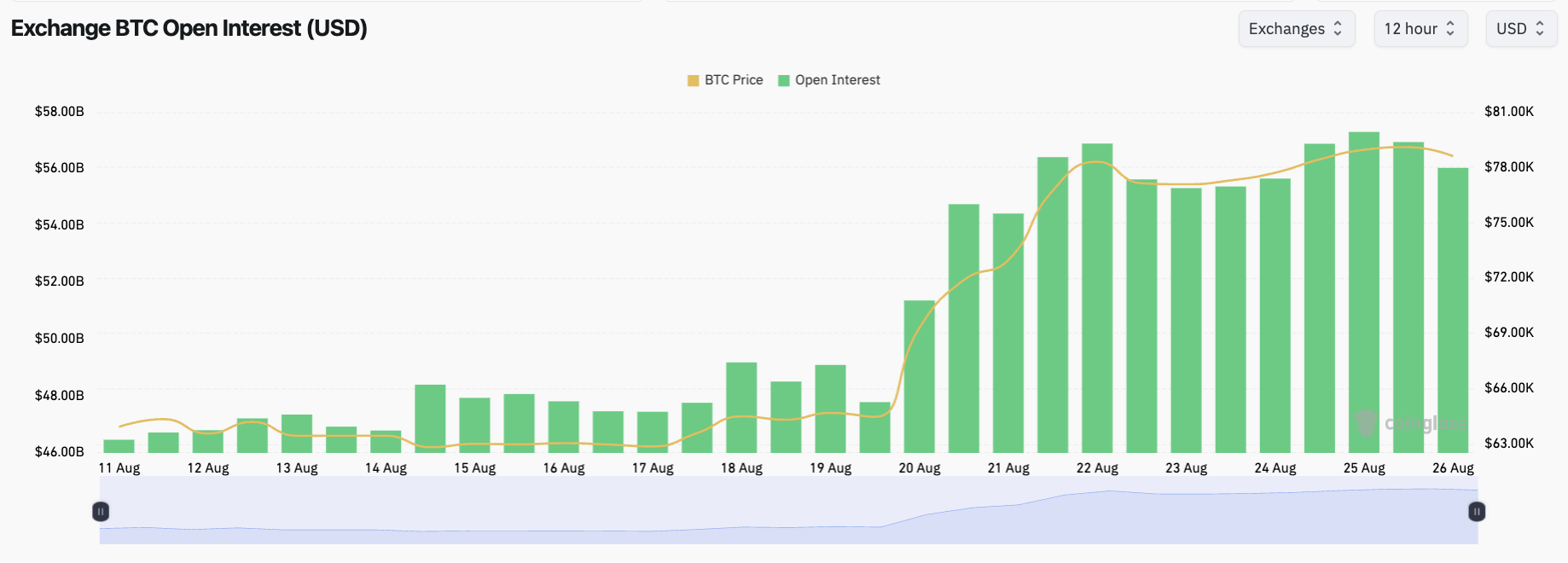
Bitcoin has climbed approximately 32% from its July 1 low near $58,559 and has reclaimed the 30-day moving average with more conviction than any prior attempt this year. That recovery is real. The open question is whether it is the beginning of a sustained trend change or another rally within a larger range.
The answer will likely be determined by a single well-defined level: the 50-week exponential moving average, which has capped every significant rally throughout this year's downtrend. Bitcoin is now pressing directly against it. A weekly close above the 50-week EMA with follow-through would represent a meaningful structural shift. A rejection and pullback toward the lower end of the 80,000 range that has defined recent months would confirm the pattern is still intact.

One technical factor is moving in Bitcoin's favor regardless of near-term price action. The descending macro trend line, the slope of lower highs that has defined the downtrend, sits near $79,600 currently but is expected to drift toward $76,300 in September. The resistance ceiling is becoming less severe simply with the passage of time, which means the price level required to confirm a breakout is gradually decreasing.
The most honest read remains range-bound with an upward bias, but that upward bias only materialises if the 50-week EMA gives way as resistance and becomes support.
XRP and HYPE: The Altcoin Rotation Question
XRP's roughly 47% gain over the past seven days has made Wintermute's $10.2 million short position particularly costly in the short term. The $11.4 million HYPE short faces similar pressure. Both moves illustrate the asymmetric risk that hedging desks accept when they short assets that can move independently and aggressively.
XRP's move is notable because it is happening while most other major altcoins lag Bitcoin's recovery, a pattern that is typical in the early stages of a potential rotation. Solana's relative strength against Bitcoin has only recently begun to improve. Historically, once Bitcoin stabilises or breaks higher, capital rotation into selected altcoins can compress months of underperformance in days or weeks.
"The same desks that are short today will often be the ones providing liquidity on the way up once the technical picture clarifies," Bitrue Research Institute's analysis notes of the current short books on XRP and HYPE. The short position is not a price target. It is a risk management tool, and when the position covers, it adds buying pressure rather than selling pressure.
What the Full Picture Shows
Strip away the narrative around Wintermute's short book and the underlying market structure is coherent. Speculative leverage has been significantly reduced following recent liquidations. The remaining large short positions are concentrated in professional hedging accounts operating as expected. Bitcoin has staged a credible 32% recovery and is testing the most clearly defined resistance in its current structure. XRP has already demonstrated its capacity to move independently and sharply.
None of this resolves in a single session. The next weekly close for Bitcoin around the 50-week EMA will carry more analytical weight than any individual firm's positioning data. Markets of this size do not turn on one desk's book. They turn when residual demand pushes through levels that have previously held.
Those levels are clearly marked. The short positions are real, the losses on them are real, and the recovery is real. The question the data does not yet answer is which force proves stronger over the next several weeks, and the answer will come from the chart, not the headline.
This release is for informational purposes only and does not constitute financial advice. Cryptocurrency markets remain volatile and macro developments can override on-chain signals. Always conduct your own research.