Highlights
- Zcash has rallied 370% over three months, touching $1,200 on September 6 for the first time in nearly a decade.
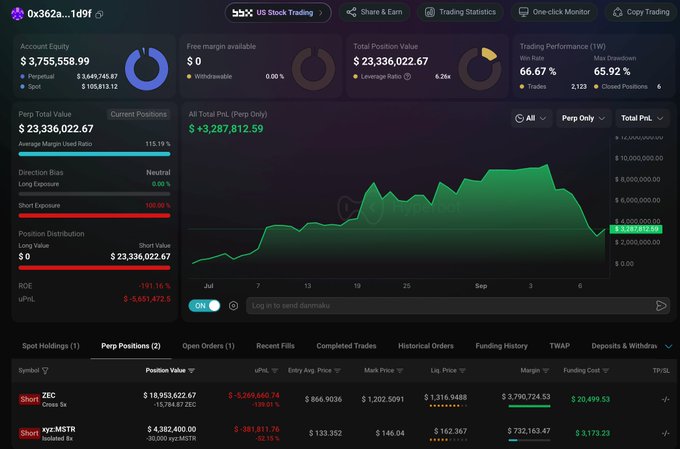
- Trader 0x362a, previously on a 26-trade winning streak, is sitting on a $5.27 million loss after shorting 15,785 ZEC just three days ago.
- Former BitForex executive Garrett Jin's short position, opened near $444 in early July, now carries a $25.7 million unrealized loss.
- Grayscale's spot Zcash ETF has crossed $400 million in assets since its August 25 launch, adding fuel to the rally.
Zcash has staged one of 2026's most dramatic altcoin rallies, climbing 370% over three months to touch $1,200 on September 6 — a level the privacy coin hasn't traded at in nearly a decade. The move has punished traders who bet against the rebound. On-chain analytics account Lookonchain flagged that trader 0x362a, who had strung together 26 consecutive winning trades, shorted 15,785 ZEC worth roughly $18.95 million just three days before the latest leg higher and is now sitting on a $5.27 million loss.
The pain is sharper still for Garrett Jin, the former BitForex executive whose short position dates back to early July and has ballooned into a $25.7 million unrealized loss as ZEC refuses to roll over.
A Short Squeeze Years in the Making
Jin's position has been one of the market's most closely watched bearish bets on Zcash. He opened a 32,760 ZEC short near $444 in early July and kept adding to it as the token climbed against him. By the time ZEC first crossed $1,000 on September 4, CoinDesk reported that short sellers had lost roughly $34 million in a single 20% leg up, with about $36.6 million in leveraged ZEC positions liquidated that day alone. Jin's unrealized loss has since widened further to $25.7 million as the token pushed past $1,200. Notably, Jin's ZEC trading history isn't uniformly bearish on outcomes — his two prior ZEC positions combined for $11.66 million in realized profit, suggesting he has closed losing squeezes before by riding out reversals rather than covering at the worst possible moment.
Jin is also holding a $107 million Bitcoin long alongside the ZEC short, which currently shows a $4.42 million unrealized gain, though he has paid roughly $2.05 million in funding fees to keep both positions open. Separately, 0x362a's reversal is notable precisely because of the trader's prior consistency: 26 straight winning trades before this one, per Zcash's climb toward multi-year highs caught even seasoned derivatives traders offside.
What's Powering the Rally
The rally's roots trace to Grayscale's spot Zcash ETF, ZCSH, which began trading on NYSE Arca on August 25 with roughly $300 million in assets and has since crossed $400 million as ZEC pushed through $1,000 and toward $1,200. The listing reframed Zcash — long a niche privacy-focused asset — as a regulated, institutionally accessible product for the first time, drawing a wave of capital that a thinly traded altcoin market wasn't positioned to absorb without violent price swings.
Related: Zcash Rockets Past $800, Its Highest Since 2018, on Grayscale ETF Push
That combination is textbook short-squeeze mechanics: as the ETF-driven bid pushed ZEC higher, leveraged short sellers were forced to post additional margin or buy back their positions to stem losses, and that forced buying added further upward pressure on price. The dynamic has echoes of similar squeezes seen elsewhere in crypto derivatives markets this year, where thin liquidity and concentrated positioning have repeatedly turned modest rallies into outsized moves. For the broader altcoin market, Zcash's run is also a reminder that capital is actively rotating into narrower, thematic corners of crypto — privacy assets, in this case — even as Bitcoin itself has spent recent weeks consolidating rather than trending.
What Comes Next
The immediate question is whether Jin and other short sellers capitulate outright or continue adding margin in hopes of a pullback, as Jin's own trading history suggests he might attempt. Grayscale's ETF asset growth is the cleanest proxy for continued institutional demand, and a slowdown in inflows there would be an early signal that the squeeze is running out of fresh buyers. Traders will also be watching ZEC's ability to hold above $1,200 as a new support level; a failure to do so could trigger the kind of rapid unwind that has hit other overextended altcoin rallies this year, potentially handing shorts like Jin's an unexpected reprieve.
FAQ
What caused Zcash's price to jump to $1,200?
The rally combined the launch of Grayscale's spot Zcash ETF on August 25, which has since crossed $400 million in assets, with a short squeeze that forced leveraged bears to buy back into a rising market, accelerating a 370% three-month gain.
How much have short sellers lost on ZEC?
Two large bets alone total more than $30 million in losses: trader 0x362a is down $5.27 million on a three-day-old short, while former BitForex executive Garrett Jin's short opened in July carries a $25.7 million unrealized loss.
Has Garrett Jin closed his ZEC short position?
As of September 7, on-chain tracking shows the position remains open, though Jin has closed ZEC shorts profitably in past cycles after being squeezed before.
What is the Grayscale Zcash ETF?
ZCSH is the first US spot Zcash exchange-traded fund, giving traditional investors regulated exposure to the privacy coin without holding it directly — a structure that has drawn institutional capital since its August 25 debut.