Highlights
- Bitcoin short-term holder whales are sitting on a record $9.07 billion in unrealized profit, according to CryptoQuant.
- The cohort covers large wallets that acquired their bitcoin recently and are historically the fastest to sell into strength.
- A similar cycle-high paper-gain spike near $10.1 billion in October 2025 preceded a wave of profit-taking.
- Analysts flag that a price wobble could quickly convert this cohort's gains into active selling pressure.
Bitcoin's short-term holder whales — large wallets that acquired their coins within the past 155 days — are now sitting on a record $9.07 billion in unrealized profit, according to on-chain analytics firm CryptoQuant. The milestone, tracked in a quicktake analysis published by CryptoQuant contributor IT_Tech_PL, marks the largest paper gain this specific cohort has held on record, and it comes as bitcoin's price has climbed enough in recent weeks to push recent buyers deep into profit rather than the underwater positions that dominated earlier in the year.
Short-term holder whales are a closely watched cohort in on-chain analysis because their behavior differs sharply from long-term holders: rather than sitting through drawdowns on conviction, they tend to react quickly to both fear and greed, since their cost basis is recent enough that price swings translate directly into large paper gains or losses.
"A cohort sitting on a record paper gain can turn into sellers the moment price wobbles, and STH whales are historically the fastest to take profit," IT_Tech_PL wrote in the CryptoQuant analysis.
The current spike is not unprecedented in scale — this same cohort's unrealized profit briefly approached roughly $10.1 billion in October 2025, a level widely described at the time as the highest of that cycle, before a subsequent bout of profit-taking pulled the metric back down. The current $9.07 billion print sits just below that prior peak, putting the market within range of a level that has previously acted as a trigger point for distribution rather than continued accumulation.
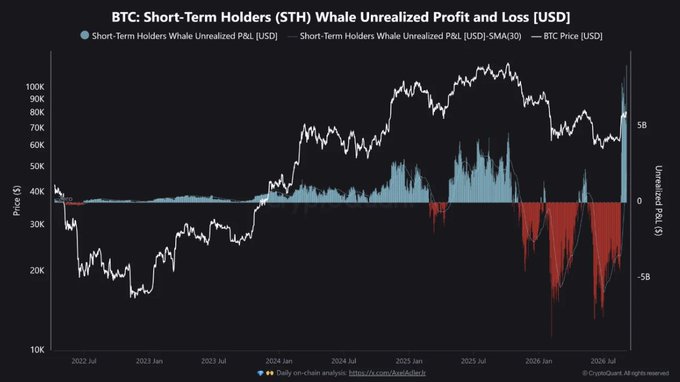
The concentration of this profit within a whale-sized cohort — rather than spread evenly across all short-term holders — is what makes the metric particularly sensitive to a market wobble. Large wallets can execute sizable sell orders quickly once sentiment shifts, and because these holders bought recently, their selling threshold is far closer to the current spot price than a long-term holder who might tolerate a 20% or 30% pullback before reconsidering. Other on-chain data has recently shown older cohorts stirring too, with realized capitalization metrics turning positive as some long-dormant supply becomes active — a combination that, if it converges with short-term whale selling, could compound downside pressure rather than offset it. Conversely, if price continues grinding higher without a sharp correction, this cohort has historically been willing to keep holding rather than lock in gains prematurely, meaning the record profit level itself is not automatically bearish.
What makes short-term holder whale behavior a useful signal rather than just a curiosity is its track record as a leading indicator: distribution from this cohort has, in prior cycles, tended to show up in exchange inflow data before it shows up in price, giving traders a window to react before broader selling pressure materializes. That also means the record profit figure functions less as a prediction and more as a measure of latent risk sitting in the market — a large pool of gains that has not yet been realized, sitting with holders whose history suggests low patience once momentum stalls. Derivatives positioning and funding rates around bitcoin perpetuals in the days following this data point are likely to reflect whether traders are pricing in that risk or dismissing it as this cycle's cohort behaving differently from the last one.
Related: Bitcoin's Stablecoin Demand Signal Starts to Fade, CryptoQuant Data Shows
The next thing to watch is simply whether bitcoin's price experiences the kind of sharp pullback that has historically flipped this cohort from holders into sellers — a move of even a few percentage points in a short window has been enough in past cycles to trigger cascading short-term holder distribution. Mid-size whale accumulation trends, exchange inflow data from this specific short-term cohort, and whether the $9.07 billion figure gets revisited or exceeded in CryptoQuant's coming updates will be the clearest signals of whether this record profit resolves into a fresh wave of selling or simply becomes the new baseline for a market that has moved decisively higher. CryptoQuant's own quicktake series has flagged similar inflection points before major moves in both directions, so traders are likely to treat any follow-up update to this specific metric as a near-term risk gauge rather than a one-off data point.
FAQ
What is a bitcoin short-term holder whale?
It refers to large wallets holding bitcoin acquired within the past 155 days, a group CryptoQuant tracks separately from long-term holders because of its more reactive trading behavior.
How large is the current unrealized profit for this cohort?
CryptoQuant data shows short-term holder whales are sitting on a record $9.07 billion in unrealized profit as of this analysis.
Has this cohort's profit been this high before?
It came close in October 2025, when unrealized profit for the same cohort approached roughly $10.1 billion, a level that preceded a subsequent wave of profit-taking.
Why does this matter for bitcoin's price?
Short-term holder whales are historically quick to sell once prices wobble, so a large concentration of unrealized profit in this group raises the risk of sudden selling pressure if sentiment shifts.