Circle spent months positioning Arc as a blockchain built for banks, not degens — a Layer 1 where transaction fees are paid in USDC, block production runs through eleven institutional validators including BlackRock, Visa, Mastercard, DTCC and ICE, and the pitch is real-time payments and programmable money rather than speculation. The network went fully live on September 16. By the end of its first full day, roughly 82% of its trading volume had nothing to do with any of that.
Arc processed about 7.83 million transactions in its first 24 hours, and generated $410.8 million in decentralized exchange volume, according to CoinDesk. Memecoin launchpads accounted for $336.3 million of that figure. Arguspad, the single largest of them, generated roughly $202.4 million on its own and was responsible for more than 83,000 of the 97,025 new tokens traders minted on the chain that day. Circle's actual flagship use case — USDC payments — barely registered by comparison: only about 624,000 USDC transfers have happened on Arc across its entire life so far, a fraction of the memecoin activity packed into a single afternoon.
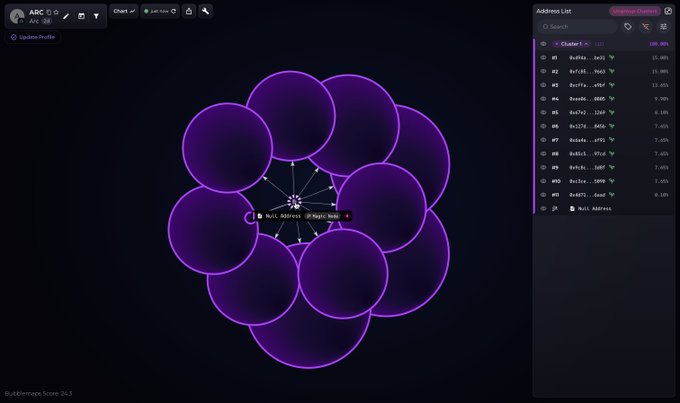
The token behind the network mints in on the same theme. Onchain-analytics firm Bubblemaps tracked Circle minting 10 billion ARC tokens and distributing them across 11 addresses through a null-address transfer, a step Arc's team described as a technical milestone in its roadmap to move from proof-of-authority to proof-of-stake. Separately, Binance Wallet added support for Arc's DeFi liquidity pools the same week, letting users provide liquidity and manage LP positions for specific pools directly from Binance's app — infrastructure clearly built with more than memecoin trading in mind, even if that's what showed up first.
Prices for the day's biggest launches have already round-tripped hard. TOLLY is down 56% from its high, LONG has fallen 77%, and COOL has dropped 75%, the kind of whipsaw that's become a signature of launchpad-driven token debuts on new chains. one early Arguspad trader turned a $1,200 bet into $361,000 before that pullback set in, and the pattern didn't escape notice from within the crypto trading community. Bonk Guy, a trader whose commentary carries weight in launchpad circles, posted a caution to followers that Arc "is not the next Robinhood, BNB, or Solana" and that treating it like a comparable chain "could lead to losses."
Related: Arc Chain Tokens Rip 400-10,000% as $127M Trades Against Thin Liquidity
The comparison Bonk Guy was pushing back against is an obvious one: Robinhood Chain went through an almost identical script when it launched on July 12, drawing $878 million in day-one DEX volume — more than double what Arc did — as its own institutional payments pitch got buried under launchpad trading. Robinhood Chain has since built real staying power in daily revenue terms, which is the open question hanging over Arc now: whether Wednesday's memecoin flood is a first-day curiosity that fades as institutional volume ramps up, or the actual demand curve for a chain that spent a year building for banks and got discovered by degens first.
The institutional side of the launch wasn't vaporware, even if it got drowned out. More than 100 institutional and ecosystem builders went live alongside the eleven founding validators, with Aave and Morpho anchoring onchain lending markets from day one and trading venues including Aerodrome and Uniswap already routing liquidity through the chain. That's the split Arc has to manage going forward: a validator set built from BlackRock, Visa, Mastercard, DTCC and ICE sitting on top of a transaction ledger where, on launch day, memecoin launchpads outnumbered payment transfers by more than 500 to one.
Arc's own grant programs suggest the team is trying to steer that curve. The network opened a $10,000 microgrant round this week offering 20 early-stage projects $500 USDC apiece, open to mini-apps, prototypes and proof-of-concepts running on the Arc mainnet, with applications due October 14 and no equity or IP strings attached — a small, deliberately low-stakes attempt to seed the kind of builder activity Circle actually designed the chain for.