Highlights
- Profitable Bitcoin supply climbed from 65% in May to 68% by late August
- Long-term holders' share of realized profit fell to 47%, down from 88% at August's peak
- September's realized-profit spike is running at under half August's size
- Altcoins slipped against Bitcoin again as capital concentrated in the market leader
Glassnode's latest Market Compass reading carries a blunt one-line verdict: the market is "repairing, still risk-off." The on-chain analytics firm's data shows why that caution is warranted, even after weeks in which Bitcoin has repeatedly tested and retested prior highs.
The core dynamic is a swelling pool of profitable supply. Summer accumulation reset the Short-Term Holder cost basis to roughly $71,000, which means identical nominal prices near recent highs now activate a much larger volume of profitable coins than they did a few months ago. The share of Bitcoin's circulating supply sitting in profit rose from 65% in May to 68% by late August, according to Glassnode's tracking, expanding the pool of latent sell-side liquidity every time price approaches a prior peak.
Who is actually taking that profit has changed meaningfully. Long-term holders, coins held longer than roughly six months, accounted for 88% of realized profit at August's peak, a figure that has since fallen to 47%. Glassnode's research team reads this shift as evidence that September's selling is coming disproportionately from recent buyers cashing out quickly rather than seasoned holders distributing into strength, and the overall realized-profit spike this month is running at under half the size of August's. That is a meaningfully different market structure than a classic distribution top, where long-term holders typically dominate the selling as they exit positions built years earlier.
Related: Whale Buys 36,360 ZEC Worth $41.56M Over Six Days as Zcash Cools From Highs
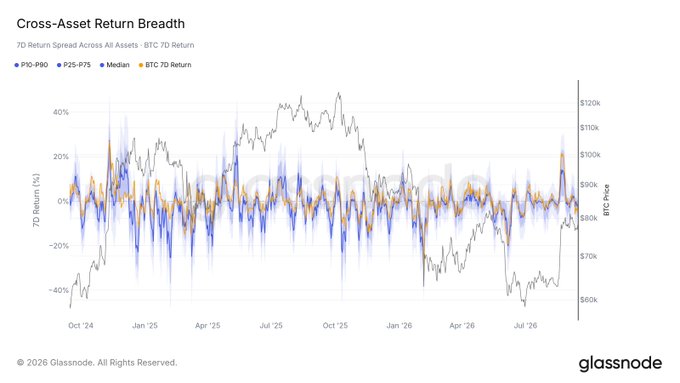
Altcoins are the weaker side of this picture. Glassnode's data shows altcoins slipping against Bitcoin again through the period, with capital concentrating in the market leader rather than rotating outward the way it has at prior cyclical highs. That is a notable divergence from past bull-market patterns, in which altcoins typically began outperforming Bitcoin once the broader market moved into a genuine risk-on phase; instead, the current setup looks more like risk being reduced across the board, with Bitcoin simply losing less ground than everything else. Not every corner of the altcoin market is struggling equally, though: privacy coins have surged 213% in 2026, comfortably outrunning every other crypto sector even as the broader altcoin basket lags Bitcoin, a reminder that sector-level dispersion can look very different from the aggregate picture Glassnode is describing.
The combination points to a market that has cooled off from its most euphoric phase without yet resolving cleanly in either direction. An expanding pool of profitable supply is typically a headwind, since it means more coins are one further rally away from becoming attractive to sell, and roughly $1.535 billion in tokens face scheduled unlocks over the coming month, adding a separate, calendar-driven source of potential supply on top of whatever spot holders decide to do. Against that backdrop, Glassnode's own framing, repairing but still risk-off, reads less like a forecast than a description of a market still working through the profit-taking its own summer rally created.
What would change that reading is a shift back toward long-term-holder-dominated selling, which historically has marked later stages of a cycle top, or a renewed rotation of capital into altcoins that would signal risk appetite genuinely returning rather than merely concentrating. Neither has happened yet. Until one does, Glassnode's data suggests the safer assumption is that the market is digesting supply that became profitable over the summer rather than building toward a fresh leg higher, and that traders positioned for an altcoin-led rotation may need to wait for Bitcoin's own overhang to clear first.