Highlights
- Trader 0xa5019 turned 100 ETH ($249,800) into $1.18M in a matter of minutes trading LAPTOP, banking over $1M in profit.
- Another trader withdrew $250,000 from Binance specifically to buy LAPTOP, ending up with roughly $3,000 after buying near the top at $218.
- On-chain sleuths flagged two wallets that claimed 4,276 LAPTOP tokens each from an airdrop and may be linked to a known Safe multisig architect.
- The split outcomes show how the same few minutes of trading produced radically different results depending on entry timing.
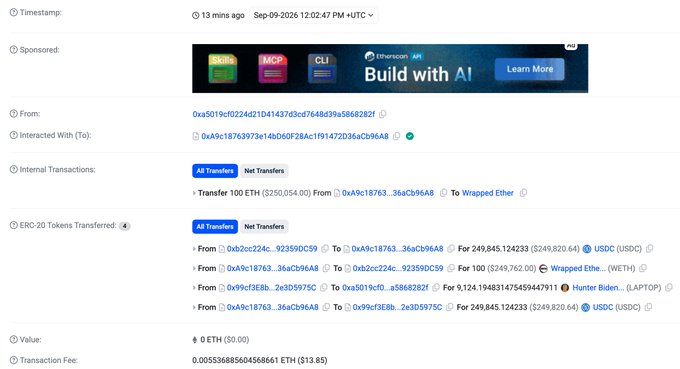
Hunter Biden's LAPTOP memecoin didn't just move violently on aggregate charts — it produced sharply divergent outcomes for individual traders who piled in during its first minutes on Base. On-chain tracker Lookonchain identified one wallet, labeled 0xa5019, that spent 100 ETH (about $249,800) to buy 9,124 LAPTOP tokens shortly after launch. The trader then sold 8,480 of those tokens for 472 ETH, worth roughly $1.18 million, while continuing to hold 644 LAPTOP tokens worth about $110,000 — pushing total profit past $1 million within minutes of the token going live.
The mirror image played out for a different trader tracked in the same window. That wallet withdrew $250,000 from Binance in advance specifically to be ready when LAPTOP launched, then bought 919 tokens at a high of $218 each — spending close to $200,000 near what turned out to be the token's peak. As LAPTOP's price collapsed in the minutes that followed, the position's value fell to roughly $3,000, wiping out nearly all of the capital deployed. The two trades happened within roughly the same half hour, separated mainly by how early each trader got in and how quickly they moved to exit.
Someone just made over $1M on @HunterBiden's $LAPTOP in just a few minutes! Trader 0xa5019 spent 100 $ETH ($249.8K) to buy 9,124 $LAPTOP, then sold 8,480 $LAPTOP for 472 $ETH ($1.18M). He still holds 644 $LAPTOP ($110K), bringing his total profit to over $1M.
Related: Hunter Biden to Launch LAPTOP Meme Coin, Airdrop TRUMP Token Losers— Lookonchain (@lookonchain) Sep 9, 2026
A Familiar Pattern in Thin-Liquidity Launches
The gap between these two outcomes is a direct function of the liquidity conditions described in coverage of LAPTOP's broader launch: a handful of pools holding well under $500,000 combined meant that whoever bought first, and sold first, captured value that later buyers simply transferred to them. It's the same dynamic that has separated winners from losers in other fast memecoin launches, including a separate trade Lookonchain flagged where a trader's FOMO purchase evaporated almost as fast as it was made. Whale Insider's tracking put LAPTOP down as much as 90% from its peak within the same stretch, underscoring how little time separated the token's high point from the bulk of the damage done to latecomers.
A Possible Link to a Known Safe Architect
Beyond the headline trades, on-chain analysts turned their attention to LAPTOP's airdrop mechanics, where 20% of supply was set aside for specific wallet groups including Hunter Biden's Substack subscribers. Roughly 40 minutes after the token launched, two addresses each claimed 4,276 LAPTOP tokens through the Substack-subscriber airdrop contract, then sold their allocations separately for profits of about $404,000 and $243,000. Analysts monitoring the addresses found an earlier ETH transfer connecting the two wallets, and traced one of them forwarding its USDC proceeds to an address publicly associated with a developer known for architecting the Safe multisig wallet infrastructure widely used across the crypto industry. The finding doesn't establish how the wallets qualified for the Substack-subscriber allocation in the first place, but it adds a governance-adjacent wrinkle to a launch already drawing scrutiny over who benefited most from its airdrop design. Safe's multisig infrastructure secures billions of dollars in treasury and custody funds across the industry, which is why analysts flagged the connection at all — a wallet with ties to that ecosystem capturing early airdrop profits reads differently than an anonymous speculator doing the same, even though the on-chain trail alone can't confirm intent or prior knowledge of the claim list.
What to Watch Next
With Gate now offering leveraged LAPTOP perpetuals and the token's remaining airdrop tranches still to be claimed, the pattern of early, well-capitalized wallets capturing outsized gains at the expense of retail latecomers is likely to keep repeating as more recipients gain the ability to sell — a dynamic that also produced a 177x gain for one trader on BSC's 4Stock earlier this year. Traders watching the token going forward will be looking at claim-contract activity for the second airdrop round, whether liquidity providers deepen the Aerodrome and Uniswap pools beyond their launch-day levels, and whether the Safe-architect connection draws any on-the-record response. Each of those would materially change how much of LAPTOP's remaining supply moves — and at what price.
FAQ
How much did the most profitable LAPTOP trader make?
Trader 0xa5019 turned a 100 ETH ($249,800) investment into more than $1 million in profit within minutes, according to Lookonchain, by selling most of a 9,124-token position while it still held value.
How much did the losing trader lose?
A trader who withdrew $250,000 from Binance to buy LAPTOP at a high of $218 per token saw the position's value fall to roughly $3,000 as the price collapsed, wiping out nearly all of the capital deployed.
What is the Safe-architect connection to the LAPTOP airdrop?
On-chain analysts found two wallets that each claimed 4,276 LAPTOP tokens from the Substack-subscriber airdrop and sold for a combined roughly $647,000 in profit; one wallet's proceeds were traced to an address associated with a developer known for the Safe multisig wallet architecture.
Why did outcomes vary so much between traders?
LAPTOP launched with only a few hundred thousand dollars of combined liquidity across its trading pools, so the timing of a trade — buying early versus buying near the top, and exiting quickly versus holding — determined whether a trader profited or lost most of their capital.