Highlights
- Raydium settles more than 63% of all Solana tokenized equity trading volume, according to on-chain data from Messari
- The DEX's dominance holds across both major issuance venues: 75% of xStocks volume and 60% of Backpack security-token volume route through Raydium
- Solana processes roughly 95% of global weekly tokenized stock volume, per rwa.xyz tracking
- Backpack overtook xStocksFi in monthly tokenized-equity volume in July, pulling in $1.06 billion despite holding just 5% of token supply
Solana's tokenized stock market has a clear center of gravity, and it isn't the token issuers themselves — it's Raydium. Data from Messari shows the automated market maker now settles more than 63% of all Solana tokenized equity trading volume, a dominance that holds consistently across the network's two largest issuance platforms: 75% of xStocks trading volume and 60% of Backpack security-token volume route through Raydium's pools.
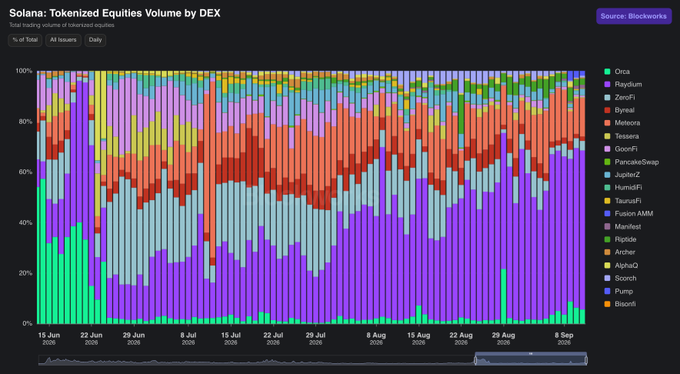
The concentration reflects Raydium's position as Solana's most liquid venue for onchain markets generally, but it takes on particular significance in the tokenized-equity niche because the space itself has grown explosively. Solana now accounts for roughly 95% of global weekly tokenized stock trading volume, according to rwa.xyz's tracking dashboard — a share so dominant that the chain has effectively become the default settlement layer for onchain equities, ahead of Ethereum and every other network combined.
xStocks and Backpack represent two competing models for how tokenized equities reach traders on Solana. xStocks has built its position primarily on breadth of supply, listing 183 tokenized assets worth roughly $482 million and holding a 26.4% share of tokenized equity value on the chain. Backpack has taken a different route, leaning on direct redeemability and its own market-making desk rather than sheer catalog size — and it worked well enough that Backpack overtook xStocksFi in monthly trading volume in July, pulling in $1.06 billion despite holding only about 5% of total tokenized-equity supply on Solana.
Related: Tokenized Stocks Add $187.8M in a Week, Leading RWA Sector Growth
That both platforms route the bulk of their trading through the same DEX suggests liquidity, not issuance, is the real bottleneck in onchain equities right now — traders go where the depth is, regardless of which platform minted the underlying token. It also mirrors a pattern showing up elsewhere in the RWA sector: tokenized stocks have been the fastest-growing corner of the real-world-asset market, adding nearly $188 million in a single week even as other RWA categories grow more slowly, and Uniswap's own RWA volume has climbed to $2.5 billion as tokenized stocks take off on Ethereum's side of the market too.
For Raydium, the numbers reinforce a role it has been building toward for months — the protocol previously touted itself as the top venue for tokenized-asset spot volume on Solana after crossing $3 billion in cumulative tokenized-equity trading earlier this year, with roughly a third of that total added in a single month. As more asset managers and neobrokers experiment with onchain equity rails, Raydium's grip on Solana trading volume positions it as one of the more direct infrastructure beneficiaries of the broader tokenization trend, even without issuing a single tokenized asset of its own.
The rise of tokenized equities has also drawn regulatory attention alongside the trading volume. Onchain stock trading blurs the line between securities and crypto-native assets, an issue regulators in Washington and Brussels are both wrestling with as tokenized real-world assets scale into the tens of billions of dollars. For now, though, trading activity has outpaced regulatory clarity, and Raydium's volume share suggests that whichever framework eventually emerges, the liquidity question in Solana's tokenized-equity market has already been answered.
What's notable is how little of this activity is visible to traders outside the Solana ecosystem. Tokenized equities still represent a niche corner of overall crypto trading volume, dwarfed by spot and perpetual markets for native tokens, yet the underlying growth rate has outpaced almost every other RWA category this year. If that trajectory holds, Raydium's current 63% share of the market gives it an outsized claim on fee revenue from a segment that traditional brokerages and neobanks are only beginning to take seriously as a distribution channel for equities outside normal market hours.