Two Ethereum wallets moved a combined $13 million off exchanges within hours of each other on Wednesday, according to data from Lookonchain, in a pair of withdrawals that fit a broader pattern of shrinking exchange reserves even as the token's price has struggled to break out.
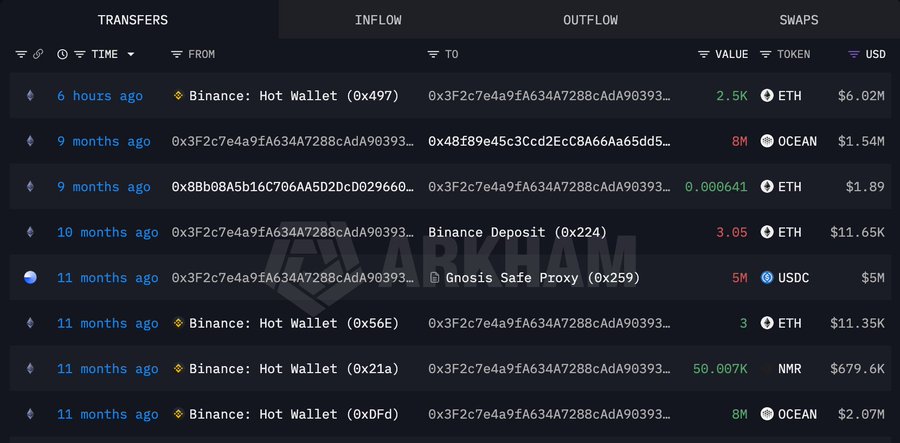
A newly created wallet, address 0xC2f1, withdrew 2,695 ETH worth roughly $6.94 million from Gemini and staked the entire amount immediately. The wallet's creation shortly before the withdrawal suggests the funds were moved from another source specifically to be locked up rather than repositioned for trading — a pattern more consistent with a long-term holder consolidating exposure than a fund managing short-term liquidity. Separately, a second address, 0x3F2c, pulled 2,500 ETH worth about $6.02 million from Binance after nine months of complete inactivity, withdrawing at a price of $2,408.42 per token. Dormant-wallet reactivations like this one tend to draw outsized attention from on-chain analysts precisely because they're rare: a wallet that hasn't moved in nine months has, by definition, sat through several full swings in ETH's price without reacting, which makes the moment it finally does move worth reading as a deliberate decision rather than routine portfolio management.
Both withdrawals land against a backdrop of thinning exchange supply. Ethereum reserves held on exchanges have fallen to roughly 14.92 million ETH, the lowest level recorded in 2026, while more than 42 million ETH — about 33.1% of circulating supply — now sits staked. Each individual withdrawal is small next to those totals, but the direction has been consistent for months: tokens are leaving exchanges faster than they're arriving, and a growing share of what remains outside exchange custody is being locked into staking rather than held liquid.
Institutional demand has moved in step with that trend. US spot Ether ETFs pulled in $196.9 million in net inflows in the week ending Sept. 11, their fourth straight week of positive flows, following $1.85 billion added in August alone. BitMine's own treasury has been growing in parallel, adding thousands of ETH at a time as it pushes its holdings toward 5% of total supply — a scale of accumulation that dwarfs either of Wednesday's individual whale moves but points in the same direction.
Related: Dormant Trader Opens $44.85M 25x Leveraged ETH Long After 7-Month Pause
Not every large holder is on the same side of that trade, though. Just weeks earlier, a mystery whale unwound an entire 167,855 ETH position over five days, cashing out roughly $408 million in one of the largest single-holder exits of the year. That sale is a useful reminder that on-chain accumulation signals like Wednesday's two withdrawals are directional but not decisive — for every wallet quietly staking fresh ETH, another can just as easily be moving in the opposite direction at far larger scale.
What makes Wednesday's pair notable isn't the size, which is modest next to institutional treasury purchases or ETF flows, but the behavior. A freshly funded wallet that stakes immediately signals conviction in holding through volatility rather than trading around it, while a nine-month-dormant address waking up specifically to pull funds off an exchange — rather than simply leaving them parked — suggests its owner is repositioning for a move rather than reacting to one. With ETH still trading in a tight band, both wallets are effectively placing early bets on which direction that range breaks.
The broader staking math is part of what makes even modest withdrawals like these worth tracking. Every ETH that moves from an exchange balance into a validator or staking pool is, in practical terms, removed from the pool of tokens that could be sold quickly if sentiment turns — and with roughly a third of circulating supply already locked up, incremental withdrawals compound a supply squeeze that's been building for months rather than acting as one-off events. Analysts watching exchange-reserve data have flagged that trend as one of the more reliable structural tailwinds for ETH even during stretches, like the current one, when price action itself has been flat.