For the first time in twelve months, Bitcoin's options market is pricing in more fear of missing a rally than fear of a crash.
The shift shows up in the 25-delta skew, a derivatives gauge that measures whether traders are paying a premium for downside put protection or upside call exposure. That skew turned positive on August 20 — the first time it has done so in a year — meaning demand for bullish call options has now overtaken demand for bearish puts, according to a Bitcoin.com News report. Traders describe the move as the market shifting its attention from downside floors to upside ceilings after months spent preoccupied with the former.
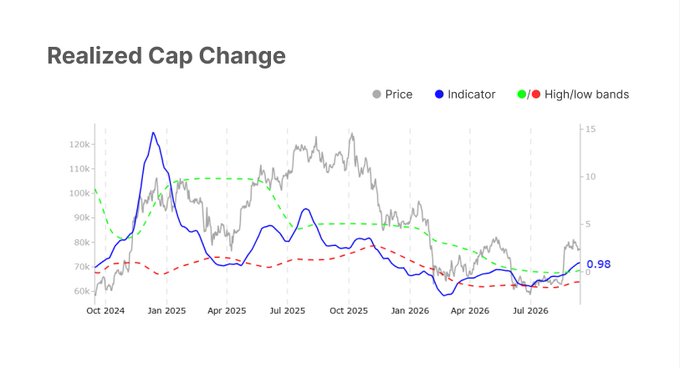
The positioning data backs up the sentiment shift. As of Monday morning, Bitcoin futures open interest stood at roughly 676,820 BTC, worth about $52.64 billion, with Binance alone accounting for 142,870 BTC ($11.11 billion), or 21.1% of the total. In the options market, calls made up 61.39% of open interest (roughly 305,530 BTC) against 38.61% for puts (about 192,126 BTC), and 24-hour call volume has been outpacing put volume. Large clusters of open positions sit at the $80,000, $85,000, $90,000 and $100,000 strikes, with one of the more notable single positions a $70,000 call expiring September 25.
Spot markets are more subdued than the options tilt might suggest. Bitcoin was sitting around $78,000, down roughly 1% on the week and holding within its recent range. Glassnode noted that “spot and perpetual selling and ETF outflows weigh, but capital inflows and elevated profitability show a market absorbing pressure, not breaking down” — a read that casts the sideways chop as consolidation rather than the start of a deeper leg down, a framing echoed in recent ETF demand data.
Related: Bitcoin's $78K Line in the Sand: Long-Term Holders Buy as Traders Eye $74K
Chart watchers are focused on the same price zone the options desks are pricing around. Bitcoin has been rebounding into an old support level near $78,300, and the question now is whether that level flips into resistance on the way back up. A failure to clear it and hold would tend to confirm the breakdown that followed the most recent weekly close below the range, keeping a retest of lower levels on the table even as options flow leans bullish.
The skew flip lands at an awkward moment for anyone looking for a clean signal: it arrives just days ahead of a Federal Reserve decision that markets widely expect to produce the first rate hike since 2023, a macro backdrop that has been driving volatility across risk assets well beyond crypto. Options traders positioning for higher Bitcoin prices does not guarantee the spot market follows through, particularly if a hawkish Fed surprise triggers a broader risk-off reaction — but it does mark a meaningful change in tone after a year in which downside protection was consistently the more expensive trade.
FAQ
What does a positive 25-delta skew mean for Bitcoin?
It means options traders are paying more for bullish call options than for bearish put options, signaling the market expects upside is more likely, or at least worth paying up to capture, than a sharp decline.
Why does the first bullish skew in 12 months matter?
For a full year, the options market had consistently priced in more demand for crash protection than upside exposure. The flip on August 20 marks the first time sentiment has tilted back toward bullish positioning since then.
Does this mean Bitcoin's price is about to rally?
Not necessarily. Options positioning reflects trader expectations and hedging demand, not a guarantee of future price action — spot Bitcoin was still holding a tight range near $78,000 even as the skew turned positive.