Uniswap's hook ecosystem just notched its fifth consecutive week of record volume, according to on-chain tracking cited by Messari. The streak has been building since early August and points to accelerating usage of the customizable smart-contract logic that Uniswap v4 introduced as its core architectural bet.
Hooks are the feature that sets v4 apart from earlier Uniswap versions: rather than every pool running the same fixed automated-market-maker logic, developers can plug in custom code that runs at specific points in a pool's lifecycle — enabling dynamic fees that adjust to volatility, on-chain MEV mitigation, custom order types and other bespoke market behavior that previously would have required forking the protocol entirely. It was the most technically ambitious piece of v4's design, and the one whose real-world adoption was hardest to predict in advance.
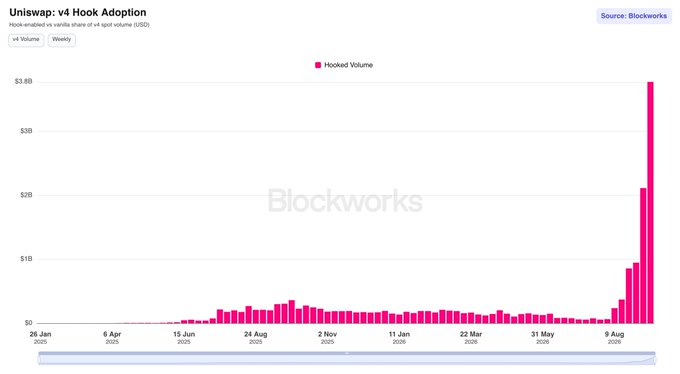
The volume data lines up with a broader acceleration across v4. Uniswap's v4 deployment logged roughly $38 billion in 30-day trading volume as of mid-September, contributing to total monthly Uniswap volume that has topped $70 billion — more than its three closest decentralized-exchange rivals combined. Cumulative v4 volume has climbed to roughly $355 billion since launch, split between about $190 billion on Ethereum mainnet and $70 billion on Unichain, with v4 pools now handling close to 30% of all Uniswap swap volume across the ten chains the protocol operates on.
Part of the growth is coming from newer chains where hook-enabled pools are capturing flow that older AMM designs would have missed. Uniswap's deployment on Robinhood Chain, for instance, hit a $130 million all-time-high volume milestone in late August — one of the more visible recent examples of v4 pools picking up activity outside Ethereum mainnet, and a dynamic that overlaps with Uniswap's growing volume in tokenized-asset markets, where dynamic-fee hooks are particularly useful for managing volatility around real-world-asset pricing.
Related: RWA Perpetual Markets Top 1,000 as Tokenized Stocks Dominate
Major DEX aggregators have also been routing a larger share of order flow through v4 pools since adoption picked up in mid-2025, and hundreds of custom hooks are now live across Uniswap's multichain footprint — everything from limit-order functionality to liquidity-management strategies built by third-party teams rather than the Uniswap Foundation itself. That's the outcome the v4 design was meant to produce: turning Uniswap from a single product into a platform other developers build on top of.
How much of the volume is genuinely new trading activity versus liquidity migrating over from v2 and v3 pools, or incentivized flow tied to fresh hook launches, is harder to isolate from public dashboards alone — a caveat worth keeping in mind before reading a five-week streak as proof the feature has fully arrived. Still, sustained, compounding growth over more than a month is a meaningfully different signal than a single volume spike, and it's the clearest evidence yet that developers building on top of v4's hook architecture are starting to pull real liquidity rather than just technical interest.