Matrixport moved in two directions on Binance within the same window Monday: on-chain analytics firm Lookonchain flagged a deposit of 1,400 BTC, worth roughly $107.8 million, onto the exchange, alongside a withdrawal of 10,000 ETH, worth about $24.7 million, off of it. The two flows were tracked independently through the wallet addresses Lookonchain published alongside the transactions, and the same movement was corroborated by a separate wire report citing identical figures within the hour, leaving little ambiguity about the scale or direction of either leg.
The split is the detail traders are picking over. Moving Bitcoin onto an exchange is the classic precursor to a sale or to posting collateral for a leveraged position, while pulling Ether off one is usually read as the opposite: a move toward self-custody or longer-term holding, away from a venue where it could be sold quickly. Seeing both from the same entity within the same window reads less like a single directional bet and more like a treasury rebalancing exercise, or two desks within the same firm executing unrelated mandates on the same day.
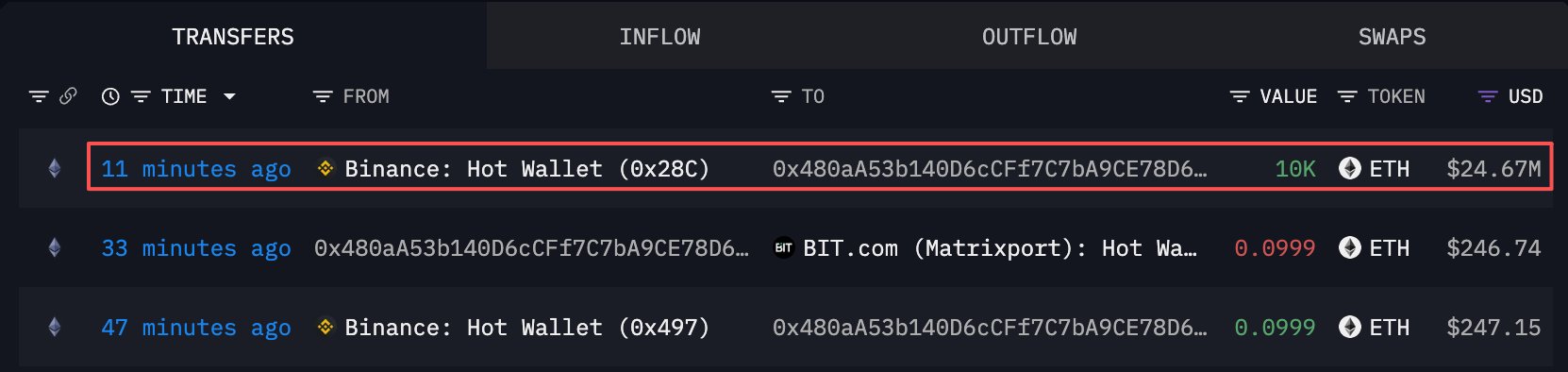
Matrixport, the crypto financial services firm that has operated under both its original name and the “BIT” brand across various product lines, has a track record of moving large, round-number blocks of BTC and ETH on and off Binance, and outside observers have learned to treat any single transfer as a data point rather than a verdict. The firm offers custody, lending, and structured products to institutional clients, which means its wallets can reflect client-driven flows as much as the firm's own positioning, and a deposit sized at a clean 1,400 BTC is as consistent with routing collateral for a client-facing product as it is with proprietary selling. The firm has shown up on wallet-tracking dashboards repeatedly over the past year, sometimes pulling nine-figure sums of Bitcoin off exchanges and other times sending them the other way, and neither direction has reliably predicted where price went next.
Still, the dollar figures are large enough to register on trackers that watch exchange netflows as a sentiment gauge. A nine-figure Bitcoin deposit lands at a moment when a record volume of BTC and ETH options is set to expire, and any concentrated inflow to an exchange order book, even one that turns out to be operationally routine, tends to get read by algorithmic trackers as incremental sell-side pressure until proven otherwise. The Ether withdrawal cuts the other way, adding to a broader pattern in which institutional Ether demand has been comparatively resilient even as Bitcoin has wobbled.
Related: Bitcoin Tops $79,000, Ether Reclaims $2,600 as $100M in Shorts Wiped Out
None of this confirms intent on Matrixport's part, and the firm has not issued public comment on the transfers. What the episode does illustrate is how granular on-chain monitoring has become: a firm can no longer move size across a major exchange without a wallet-tracking desk publishing the exact BTC and ETH amounts, in dollar terms, within minutes. That transparency cuts both ways for large holders, and it is part of why leveraged whale positioning across both assets has become as closely watched as spot price itself. For now, the market's read is a cautious one: neither flow is large enough on its own to move Bitcoin or Ether's price meaningfully, but the pairing is exactly the kind of ambiguous signal that keeps traders checking exchange-flow dashboards well before checking the price chart. If anything, the episode is a reminder that not every large wallet movement needs a narrative attached to it: sometimes a treasury desk is simply squaring positions across two different assets on the same afternoon, and the market is left to decide how much weight that deserves.