Strategy said Monday that its US-dollar assets now cover 3.9 years of the company's annual interest and dividend obligations on its outstanding debt and preferred stock, the latest data point in a running effort by the Bitcoin treasury company to convince skeptics that its capital structure can survive a prolonged downturn without forced selling.
The figure, posted by Strategy's own account alongside references to $MSTR and $STRC, updates a metric the company has published with increasing frequency since rolling out its USD Reserve and Digital Credit Capital Framework earlier this year. The reserve exists for one purpose: to make sure Strategy can keep paying cash interest and preferred dividends even if Bitcoin's price falls hard enough, or stays low long enough, that selling BTC to cover those obligations would look like desperation rather than strategy.
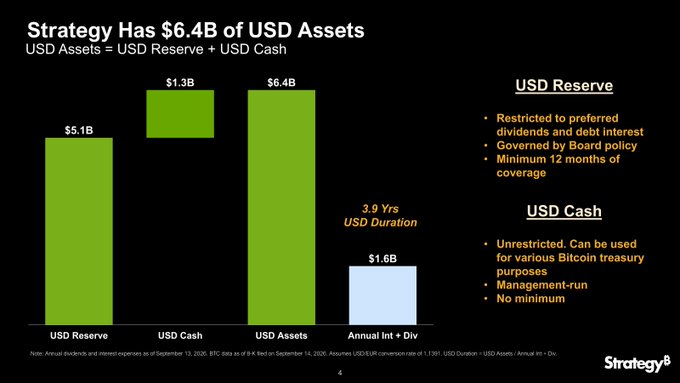
The math behind Monday's figure lines up with recent disclosures. The Block reported the same day that Strategy had repurchased roughly $139 million of STRC preferred shares between September 8 and September 13, funded out of its separate USD Cash pool rather than its USD Reserve, while leaving its core Bitcoin holdings — 845,050 BTC, worth roughly $65.7 billion — untouched for a second straight week. Strategy's USD Reserve and USD Cash balances stood at roughly $5.1 billion and $1.3 billion respectively as of the same date, a combined cash position north of $6 billion.
Set against Strategy's growing stack of preferred issuances — STRC, STRF, STRK and STRD, each carrying its own dividend rate, plus interest on its convertible notes — that combined cash position works out to multiple years of coverage at current obligation levels, consistent with the 3.9-year figure the company disclosed. It's a meaningfully longer runway than the roughly 17-to-26-month coverage windows Strategy had cited for narrower slices of its obligations earlier in the year, reflecting both a larger cash buffer and the pace at which the company has been building it through its BTC Monetization Program.
That program — which lets Strategy sell portions of its Bitcoin stack specifically to fund the reserve, dividends and share buybacks — has become the company's preferred lever when it wants to manage its capital structure without touching its core treasury thesis. Selling BTC to buy back preferred shares at a discount, as Strategy has done repeatedly in recent weeks, both shrinks the share count of higher-yielding instruments and signals confidence that the company doesn't need to hoard every dollar of cash against a worst-case scenario.
Related: Saylor: Strategy's Reserve Capital Now Trails Only Berkshire on S&P 500
The distinction Strategy is drawing matters because it goes to the heart of the bear case against its model: that a big enough Bitcoin drawdown eventually forces it to sell BTC into a falling market just to make interest and dividend payments, a spiral that would validate the “Bitcoin treasury company” skeptics rather than the believers. A multi-year coverage buffer, funded and refilled independently of day-to-day BTC price action, is Strategy's answer to that argument — though it's a buffer the company has only had to test in a market that's mostly been rising.
FAQ
What is Strategy's USD Reserve?
It's a cash pool Strategy set aside specifically to pay preferred stock dividends and interest expense on its debt, kept separate from its Bitcoin holdings and from its broader USD Cash pool used for buybacks and other treasury needs.
What is STRC?
STRC is one of Strategy's preferred stock series, an income-focused instrument that pays a fixed dividend rate in cash rather than tracking Bitcoin's price the way its common stock, MSTR, does.
How does Strategy fund the reserve if Bitcoin falls?
Through its BTC Monetization Program, which allows the company to sell a defined portion of its Bitcoin holdings specifically to replenish the USD Reserve or fund dividends, interest and buybacks.