Two months ago, a trader identified on-chain as @Natan_benish spent $3,800 buying a token called AI on Robinhood Chain, when the token's entire market capitalization was just $219,800. They never sold. According to wallet-tracking platform Arkham, that original position is now worth $2.92 million — a 758x return — and represents just part of a much larger stake: the trader currently holds $6.38 million worth of AI in total, with roughly 54% of that stack having been transferred in from other wallets rather than bought outright on the open market.
AI, formally known as Artificial Inu, has become one of the more structurally unusual tokens to emerge from Robinhood Chain since the network's July 1 launch. Rather than functioning purely as a speculative meme coin, its treasury has come to hold a meaningful slice of tokenized Nvidia stock circulating on the chain — on-chain data has shown as much as 23% of Robinhood Chain's tokenized NVDA supply sitting inside AI's own treasury contract, an unusual structure that ties the meme token's value partly to a real, dividend-bearing equity rather than pure speculation. The token traded below a penny at the start of August before climbing toward its current levels, a run that has minted several outsized winners beyond @Natan_benish's position — echoing a separate case where a trader turned $1,200 into $361,000, a 302x gain, on a different chain's breakout token this year.
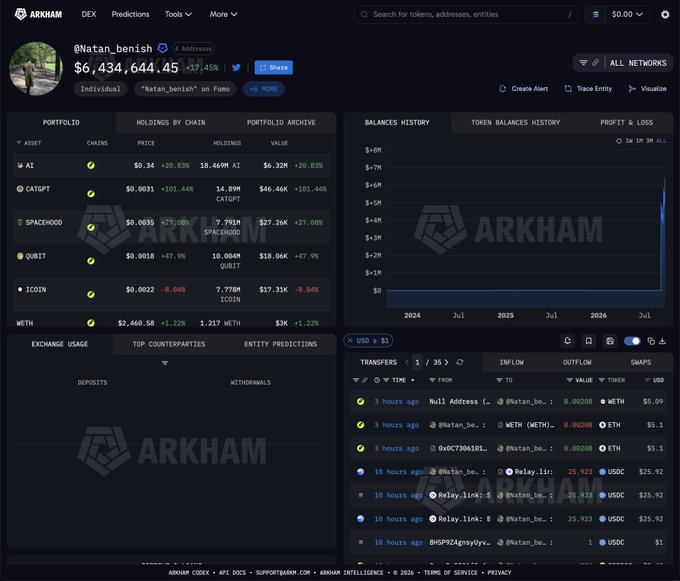
A second trader books a smaller, but still substantial, win
Trader Salem sold 6.096 million AI tokens roughly four hours before the token's biggest single moves, pocketing about $2.03 million at a $0.33 sale price. Salem still holds 17.5 million AI tokens worth an additional $5.84 million at current prices, bringing their combined realized and unrealized profit on the token to approximately $7.56 million. Unlike @Natan_benish's largely buy-and-hold position, Salem's activity shows a trader actively taking partial profits while keeping the bulk of the position intact — a more conservative approach to the same underlying trade.
Related: Early PONS Buyer Turns $249K Into $2.81M Gain After 12.3x Run
Robinhood Chain's launchpad economy keeps minting these outcomes
AI's run is the latest example of a pattern that has defined Robinhood Chain's first two months: a small set of tokens launched through the network's competing launchpads — first Noxa, then Pons after it captured the larger share of new deployments in mid-July — repeatedly turning modest early positions into seven-figure gains for the traders who bought in before broader attention arrived. The chain's daily decentralized exchange volume has already cleared $1 billion in a single session on the back of this speculative activity, with AI representing one of the largest individual winners to emerge so far — even as Solana has recently reclaimed the overall DEX volume crown from Robinhood Chain, a sign the two networks' speculative token economies remain closely matched.
Whether AI's treasury-linked structure gives it more durability than a typical Robinhood Chain launch token remains untested; the position both traders are sitting on has only existed for roughly two months, and a token whose value is partly tied to a volatile tokenized equity carries its own risks distinct from a standard meme coin. For now, though, the on-chain numbers are unambiguous: two traders who got in early are sitting on a combined unrealized and realized gain north of $10 million — a scale of win that puts them in the same territory as the $4.4 million a fresh STONK whale just dropped into a different chain's own wild speculative run.
The size of those gains also illustrates how concentrated Robinhood Chain's speculative activity has become around a small number of breakout tokens. With Pons Launchpad alone accounting for well over a third of new token deployments on the network since mid-July, thousands of tokens have launched competing for the same pool of early attention — meaning the handful that do break out, like AI, tend to absorb an outsized share of the chain's total trading volume and produce correspondingly outsized returns for whoever bought before the crowd noticed. Both traders' positions remain fully on-chain and trackable in real time, which is precisely how Arkham was able to surface the trade in the first place — a level of transparency that cuts both ways, letting the market watch winners rack up gains just as easily as it will watch if and when either trader eventually decides to sell.